The efficacy and safety of ixekizumab in the treatment of spondyloarthritis under the conditions of real clinical practice




















DOI: 10.32364/2587-6821-2023-7-3-137-143
A.D. Meshkov1, V.S. Ostapenko1,2, V.S. Pykhtina1
1Autonomous Structural Unit — Russian Gerontology Research and Clinical Center, Pirogov Russian National Research Medical University, Moscow, Russian Federation
2Pirogov Russian National Research Medical University, Moscow, Russian Federation
Aim: to assess the efficacy and safety of ixekizumab in the treatment of ankylosing spondyloarthritis (AS) and psoriatic arthritis (PA) in real clinical practice.
Patients and Methods: this retrospective study included patients with AS and PA who received ixekizumab therapy from February 2021 to April 2022. Disease activity was evaluated every 3–6 months, using BASDAI and ASDAS scores for AS and DAPSA и PASI scores for PA. C-reactive protein (CRP) served as a serologic marker of disease activity.
Results: the analysis included the data received for 27 patients, of whom 10 persons had AS and 17 — PA. The safety of treatment was assessed in all patients, and the data of 9 AS and 16 PA patients were included in the analysis of the treatment efficacy. In the AS group (4 males and 5 females), the median age at the therapy initiation was 34 [32; 41.5] years and in the PA group (11 males and 6 females — 40 [32.5; 48.5] years. Failure or intolerance of the standard therapy was reported in all patients. Prior to ixekizumab treatment, most patients did not receive targeted therapies. Of 27 patients, 4 received genetically engineered biological drugs / targeted synthesized drugs which failed to achieve remission / low disease activity. In the AS group, the elevated levels of CRP were revealed in 7 (77.8%) patients, ASDAS demonstrated the presence of disease activity in all patients. According to BASDAI, disease activity was recorded in 7 (77.8%) cases. During the treatment, there was a downtrend in the percentage of patients with high disease activity as shown by ASDAS and BASDAI scores, as well as in the percentage of patients with elevated levels of CRP, while the BASDAI values were statistically significant (p=0.031). In the PA group, elevated CRP levels were reported in 62.5% of patients, and DAPSA scores represented moderate of high activity in 75.0% of patients. As a result of the treatment, there was a decrease in the percentage of patients with higher DAPSA scores and elevated CRP levels, but the changes did not achieve statistical significance. Side effects were reported in 7.4% of patients, but there were no serious adverse events.
Conclusion: acording to our data ixekizumab has shown efficacy and safety in the treatment of PA and AS in real clinical practice.
Keywords: ixekizumab, real clinical practice, psoriatic arthritis, ankylosing spondyloarthritis, genetically engineered biological drugs.
For citation: Meshkov A.D., Ostapenko V.S., Pykhtina V.S. The efficacy and safety of ixekizumab in the treatment of spondyloarthritis under the conditions of real clinical practice. Russian Medical Inquiry. 2023;7(3):137–143 (in Russ.). DOI: 10.32364/2587-6821-2023-7-3-137-143.
Background
Ankylosing spondylitis (AS) and psoriatic arthritis (PsA) are the most common spondyloarthritis (SpA) [1] that significantly reduce the quality of life and its duration. Currently, new drugs emerge as well as new indications for previously designed drugs to treat these conditions are approved.
Ixekizumab, a drug of the interleukin (IL) 17 inhibitor family, was approved in the Russian Federation for psoriasis, PsA, and AS in 2019. Later, nonradiographic axial spondyloarthritis (nr-axSpA) was added1. There are specificity in terminology, i.e., in Europe, chronic inflammatory disease affecting axial skeleton is referred to as axial spondyloarthritis (axSpA), which, in turn, includes radiographic axSpA (r-axSpA), or AS, and nr-axSpA [2–4]. The difference is in the presence or absence of reliable sacroiliitis by plain radiography. According to the Russian version of the Modified New York criteria for AS2, both r-axSpA (classic AS with radiographic signs) and np-axSpa (verified by reliable MR signs of axial damage and called AS), are classified as AS. Nevertheless, discrepancies in terminology do not change the essence of the process.
Patients with axSpA (AS) have chronic inflammatory back pain. In addition, extraaxial manifestations ( e.g.,peripheral arthritis, enthesitis, dactylitis, uveitis, psoriasis, or inflammatory bowel disease) are reported as well [4, 5–7]. Patients with r-axSpA (AS), persistent disease activity (eg, BASDAI index >4), and poor response to nonsteroidal anti-inflammatory drugs (NSAIDs) or their intolerance require genetically engineered biological agents (GEBAs) or targeted drugs [4]. Currently, inhibitors of tumor necrosis factorα (TNF α), IL-17, and Janus kinase are used for ax-SpA.
Ixekizumab is a high-affinity monoclonal antibody that selectively targets IL-17A [8]. Ixekizumab has demonstrated efficacy and safety in three phase III randomized, placebo-controlled trials. Two trials included GEBA-naïve patients with active r-axSpA (COAST-V) [9, 10] or patients who were previously treated with one or two TNF α inhibitors (COAST-W) [9, 11].
PsA is mainly characterized by inflammation of peripheral joints (arthritis), finger and toe joints (dactylitis), enthesis (enthesitis), vertebral bodies (spondylitis), and iliosacral joints (sacroiliitis)3.
Psoriatic arthritis is diagnosed in 19.7% of patients with psoriasis and 24.6% of patients with moderate and severe psoriasis [2]. In PsA, inflammation affects the musculoskeletal system (joints, spine, enthesis), skin, nails (psoriasis), gastrointestinal tract (inflammatory bowel disease), and eye (uveitis, iridocyclitis).
Treatment for PsA involves drugs that relieve arthritis symptoms, i.e., NSAIDs, intra-articular corticosteroids, synthetic disease-modifying antirheumatic drugs (sDMARDs), targeted synthetic DMARDs (tsDMARDs), and GEBAs with various mechanisms of action, in particular, TNF α, IL-12/23, and IL-17 inhibitors [1, 2–4].
The efficacy of ixekizumab in PsA was studied during the SPIRIT trial. SPIRIT-H2H is a phase III randomized clinical trial (RCT) that evaluated the efficacy of two dosing regimens of ixekizumab vs. adalimumab in biological agent-naïve moderate and refractory PsA. Ixekizumab was the first drug to demonstrate superior efficacy when compared directly with adalimumab in terms of achieving both ACR50 and PASI100 [12].
Although some RCTs strongly demonstrate the efficacy and safety of ixekizumab [9, 10, 12, 13], real-world evidence is undoubtedly interesting. Patients who receive treatment beyond clinical trials are a more heterogeneous group (given the lack of the need to meet inclusion criteria) and have more comorbidities. Moreover, in real-world clinical practice, the mode of administration is violated more often, thereby potentially affecting final efficacy of the drug. In addition, not always a full set of data resulting from examinations by various specialists in various centers account for difficulties in analyzing data from real-world clinical practice. Various durations of therapy also make difficulties. However, considering a rather rapid effect of drugs, we included all patients who received treatment for ≥ 3 months.
Aim
To study the efficacy and safety of ixekizumab for AS and PsA in real-world clinical practice.
Patients and Methods
This retrospective observational study included patients with AS and PsA who received ixekizumab from February 2021 to April 2022. In 3 patients, therapy was initiated in other medical institutions, therefore, the data set for analysis was incomplete. The inclusion criterion was the presence of written informed consent for participation in the study. AS diagnosis was established by the Russian version of the modified New York criteria [14], PsA diagnosis was established by the CASPAR4 criteria. Before starting biological therapy and during treatment, all patients underwent tests for infections and laboratory tests based on current clinical guidelines4,5.
Disease activity was assessed once every 3–6 months based on the BASDAI and ASDAS scores for AS and DAPSA and PASI scores for PsA. BASDAI score ≥4, ASDAS score ≥1.3, and PASI score >4 suggested persistent disease activity [15, 16]. A CRP level of more than 5 mg/L was referred to as elevated. Parameters of patients who started treatment at other institutions were derived from medical records (if available).
In addition, all patients underwent laboratory tests to monitor the safety and efficacy of treatment based on current clinical guidelines. Safety of treatment for AS and PsA was mainly assessed by cytopenia, decrease in GFR, and increase in transaminase levels. CRP level included in the ASDAS (AS) and DAPSA (PsA) scores was used as a laboratory activity marker. All studies, criteria, and tests are included in the Russian clinical guidelines for AS and PsA. The objective examination implied calculation the number of painful and swollen joints and the PASI score in psoriasis.
Statistical analysis was performed using IBM® SPSS® Statistics v. 23.0 (SPSS Inc., USA). No normality tests were performed, therefore, nonparametric statistical methods were applied. Results are presented as the median and 25th and 75th percentiles (Me [25%; 75%]). To evaluate changes in parameters within the group during treatment, Wilcoxon and McNemar χ2 criteria were used. Changes in parameters during treatment were assessed by the Δ% calculated as follows: (n1–n0)/n1 × 100%. Differences were considered significant at p<0.05.
Results
Characteristics of patients. The analysis included 27 patients (10 patients with AS anf 17 patients with PsA). Treatment safety was evaluated in all patients. Treatment efficacy was evaluated in 9 AS patients and 16 PsA patients.
At the time of initiation of therapy, the median age was 34 [32; 41.5] years in the AS group (4 men and 5 women aged 29–64 years) and 40 [32.5; 48.5] years in the PsA group (11 men and 6 women aged 19–56 years).
Failure or intolerance of standard therapy was reported in all patients. Most patients did not receive targeted drugs before treatment with ixekizumab, 4 of 27 patients received GEBA/tsDMARDs that did not provide remission or low disease activity, i.e., 1 patient (PsA) received etanercept, 1 patient (PsA) received apremilast, 1 patient (PsA) received netakimab, and in 1 patient (AS), 5 inhibitors of TNF, netakimab, and secukinumab were ineffective or their effects gradually declined.
Ankylosing spondylitis
Efficacy analysis included 9 of 10 patients with AS (1 patient discontinued treatment after the first injection for personal reasons). Because patients were included in the study in real-world clinical practice, treatment duration varied from 3 to 9 months (median 4.3 [3; 6] months): 7 patients received therapy for 2–4 months and 2 patients received therapy for 8–9 months. Given rapid improvement with ixekizumab (a significant improvement was reported as early as at weeks 12–16 [11, 13]), this period was considered acceptable for analysis. 80 mg of ixekizumab was administered every 4 weeks as instructed6.
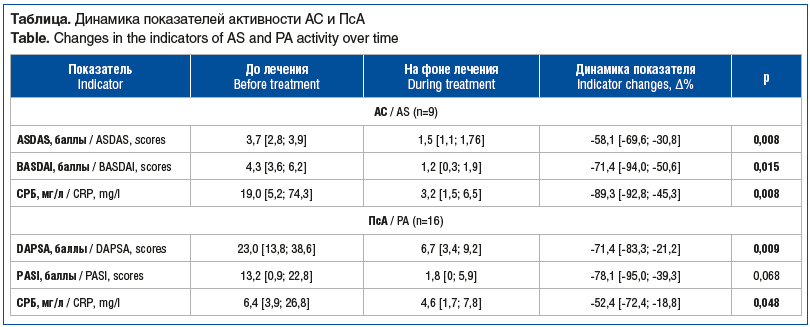
Changes in the BASAI and ASDAS scores before and after treatment are listed in the table. A significant positive trend was reported, the BASDAI score and CRP medians reduced to low activity and normal values, respectively. A decrease in the ASDAS score by 58.1% [69.6; 30.8], BASDAI score by 71.4% [94.0; 50.6], and CRP levels by 89.3% [92.8; 45.3] was also reported.
In the AS group, CRP levels increased in 7 of 9 patients(77.8%), the ASDAS score corresponded to an active disease in all patients, and disease activity (based on the BASDAI score) was reported in 77.8%. During treatment, a trend toward a decrease in the percentage of patients with high disease activity based on the ASDAS and BASDAI score and the percentage of patients with elevated CRP levels was reported. Changes in the BASDAI score were significant (see Fig. 1).
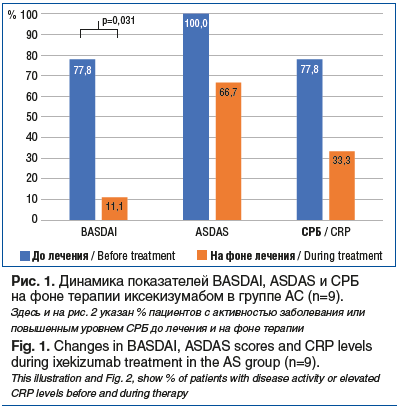
Therefore, during treatment, a significant decrease in AS activity based on CRP levels, the ASDAS and BASDAI scores, and a decrease in the percentage of patients with active disease activity based on the BASDAI score were reported.
Psoriatic arthritis
Efficacy analysis included 16 of 17 patients with PsA (data analysis of 1 patient was not performed due to insufficient follow-up period). Treatment duration varied from 3 to 22 months, the median was 3.5 months [3; 11.8]. Treatment duration was less than 4 months in 9 patients, 9–14 months in 6 patients, and 22 months in 1 patient. Given rapid improvement with ixekizumab, this period was considered acceptable for analysis. 160 mg of ixekizumab followed by 80 mg every 4 weeks were administered as instructed.
Changes in the DAPSA and PASI scores and CRP levels before and after treatment are listed in the table. A significant positive trend in the DAPSA score and CRP levels was reported, CRP median achieved normal values. The PASI did not achieve significance due to the small number of observations (n=4). The treatment result was a decrease in the DAPSA score by 71.4% [83.3; 21.2] and CRP levels by 52.4% [72.4; 18.8].
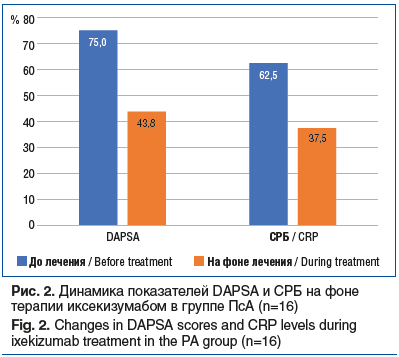
Increased CRP levels were reported in 62.5%, and the DAPSA score corresponded to moderate or high disease activity in 75.0%. The DAPSA score was elevated not in all patients, since in some of them (n=4) severe skin lesions (that is not included in calculations) but minimal activity of axial or articular disease were reported. Changes in CRP are available for 14 patients. The treatment result was a decrease in the proportion of patients with elevated DAPSA score and CRP levels, but these changes were insignificant (see Fig. 2).
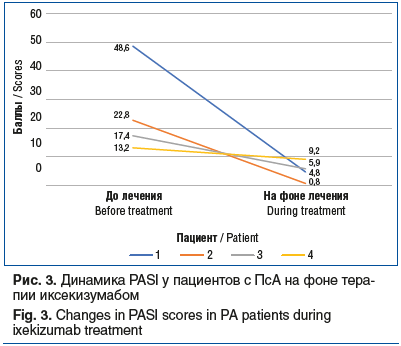
Data on changes in the PASI score of 4 patients were reported. Before treatment, the score ranged from 0 to 48.6 points. As a result , ixekizumab treatment reduced the score reduced by, on average, 78.1% [95.0; 39.3] (p=0.068), but statistical significance was not achieved. Fig. 3 illustrates changes in the PASI score of 4 patients.
Therefore, a significant reduction in PsA activity by CRP levels, the PASI and DAPSA scores, and a trend towards a decrease in skin lesion activity based on the PASI score were reported after treatment.
Adverse events
Adverse events were reported in two patients. A 22-year-old woman with PsA developed a deep furuncle of the right orbit; hence , ixekizumab was administered 2 weeks later after finishing antibacterial treatment and furuncle healing. No association with ongoing ixekizumab treatment has been established. A 43-year-old man with PsA had hyperemia and edema at the injection site after a 6-month treatment. This phenomenon was accounted for by insufficient heating of the drug. The reaction was reduced by IM antihistamines, no similar reactions were further reported. Neither death nor severe side effects were reported.
Discussion
The uniqueness of this study is the largest cohort of patients in Russia who received ixekizumab in real-world clinical practice. When analyzing this cohort, we confirmed the efficacy and safety of ixekizumab for spondyloarthritis. The analysis of domestic literature has found individual observations of the efficacy of ixekizumab therapy. No publications to analyze patient groups who received this drug have been identified, thereby making our data unique.
It is interesting to compare our findings with the results of registration clinical trials. The major difficulty is a mixed cohort of patients (bio-naïve and after prior treatment), different treatment duration, and different criteria for evaluating activity in RCTs and clinical practice. Hence, this comparison is conditional but potentially allows us to characterize a number of trends.
Ankylosing spondylitis
Given the predominance of bio-naïve patients with AS in our group, we compared our findings with the COAST-V study [10]. The ixekizumab subgroup (the drug was administered once every 4 weeks, results were evaluated by week 16) was the closest to our baseline data.
Increased CRP levels were reported in 7 patients (77.8%) of our study and 52 patients (64%) of the COAST-V study. The median CRP level before treatment was 19.0 mg/l [5.15; 74.30] in our study and 12.2±13.3 mg/l in the COAST-V study. A more common increase in CRP levels and its higher values in our cohort are potentially accounted for by the referral to GEBA patients with more severe disease course and unfavorable prognosis than in RCTs.
The median BASDAI score at baseline (before treatment) was 4.3 [3.6; 6.2] points in our study and 6.8±1.3 points in the COAST-V study. Because of ongoing therapy with ixekizumab, 8 patients (88.9%) of our study and 34 patients (42%) of the COAST-V study achieved the BASDAI score of 50. Lower BASDAI score may be due to the fact that several patients were referred for targeted therapy, primarily due to increased CRP level that is not included in calculations of the BASDAI score.
Before treatment, the median ASDAS score was 3.7 [2.8; 3.9] points in our study and the average ASDAS score was 3.7 ± 0.7 points in the COAST-V study, i.e., these values are similar. Therapy with ixekizumab reduced the ASDAS score by, on average, 58.1% [69.6; 30.8] (p=0.008) in our study and 13.8% [5.2; 22.3] (p=0.0074) in the COAST-V study. Remissions (ASDAS <1.3) were achieved in 3 patients (33.33%) in our observation and 13 patients (16%) in the COAST-V study. The low activity (ASDAS <2.1) was reported in 8 patients (88.9%) and 35 patients (43%), respectively. Hence, in our study, a reduction in the ASDAS score was more significant in similar baseline values. A more significant improvement in the BASDAI and ASDAS scores in our study is not clear. A more common inclusion of AS patients with elevated CRP levels who better respond to ixekizumab is a potential explanation [17].
Psoriatic arthritis
Given the predominance of bio-naïve patients with PsS in our group, we compared our findings with the SPIRIT-P1 study [18].
Increased CRP levels were reported in 9 patients (56.25%) in our study. Before treatment, the median CRP level was 6.4mg/l [3.9; 26.8] in our study, and the average CRP level was 9.8±13.5 mg/l in the SPIRIT-P1 study.
In our study, the key activity index was the DAPSA score. Meanwhile, randomized trials use selective activity indicators (number of painful joints and enthesitis). Therefore, it was impossible to compare this parameter at baseline and evaluate dynamic changes.
Before treatment, the median PASI score in our study was 13.2 points [0.9; 22.8], while the average PASI score in the SPIRIT-P1 study was 6.5±6.9 points, thereby illustrating more severe skin lesions in our study. Four patients (66.7%) achieved PASI 75 and 90 and two patients (33.3%) achieved PASI 100. In the SPIRIT-P1 study, 71.0%, 58.8%, and 48.9% achieved PASI 75, 90, and 100, respectively. However, it was impossible to compare the results because of the small sample in our study. Nevertheless, given a rather severe cutaneous psoriasis before starting treatment, good clinical response of skin lesions to ixekizumab was reported.
Notably, a 64-year-old woman with AS was included in our study. Despite late AS onset (60 years), the diagnosis was clear since she met the classification criteria. Given the higher risks associated with the use of targeted drugs in older patients [19], careful monitoring of treatment safety was performed in this woman. No adverse effects were reported. In general, no severe adverse effects were reported in all patients. Meanwhile, the limitations of our study are shorter (compared to registration studies) follow-up period and significantly smaller sample size. In some patients, primary assessment of drug tolerability was impossible due to the initiation of treatment in other centers.
Conclusions
In real-world clinical practice, ixekizumab has demonstrated efficacy and safety for AS and PsA. Our findings are in line with the results of large randomized trials. The benefits of surveillance are heterogeneity of the cohort (in contrast to clinical trials with clear inclusion criteria), since patients with different prior treatment, disease activity, and different ages benefit from ixekizumab. In some cases, a small sample size and limited follow-up did not allow to achieve significance of changes and compare subgroups. Nevertheless, our cohort is one of the largest in Russia. Further analysis of ixekizumab efficacy and safety requires prolonged follow-up and integration with data from other centers.
About the authors:
Aleksey D. Meshkov — C. Sc. (Med.), rheumatologist, senior researcher of the Laboratory of Musculoskeletal System Diseases, Autonomous Structural Unit — Russian Gerontology Research and Clinical Center, Pirogov Russian National Research Medical University; 16, 1st Leonov str., Moscow, 129226, Russian Federation; ORCID iD 0000-0002-5187-0108.
Valentina S. Ostapenko — C. Sc. (Med.), geriatrician, Head of the Department of Geriatric Therapy, Autonomous Structural Unit — Russian Gerontology Research and Clinical Center, Pirogov Russian National Research Medical University; 16, 1st Leonov str., Moscow, 129226, Russian Federation; associate professor of the Department of Aging-Associated Diseases, Pirogov Russian National Research Medical University; 1, Ostrovityanov str., Moscow, 117997, Russian Federation; ORCID iD 0000-0003-1222-3351.
Valentina S. Pykhtina — C. Sc. (Med.), rheumatologist, Autonomous Structural Unit — Russian Gerontology Research and Clinical Center, Pirogov Russian National Research Medical University; 16, 1st Leonov str., Moscow, 129226, Russian Federation; ORCID iD 0000-0003-0622-1886.
Contact information: Aleksey D. Meshkov, e-mail: alexeymeshkov@mail.ru.
Financial Disclosure: no authors have a financial or property interest in any material or method mentioned.
There is no conflict of interests.
Received 25.01.2023.
Revised 17.02.2023.
Accepted 14.03.2023.
2. Sieper J., Poddubnyy D. Axial spondyloarthritis. Lancet. 2017;390(10089):73–84. DOI: 10.1016/S0140-6736(16)31591-4.
3. Rudwaleit M., Khan M.A., Sieper J. The challenge of diagnosis and classification in early ankylosing spondylitis: do we need new criteria? Arthritis Rheum. 2005;52(4):1000–1008. DOI: 10.1002/art.20990.
4. Ward M.M., Deodhar A., Gensler L.S. et al. 2019 Update of the American College of Rheumatology/Spondylitis Association of America/Spondyloarthritis Research and Treatment Network Recommendations for the Treatment of Ankylosing Spondylitis and Nonradiographic Axial Spondyloarthritis. Arthritis Rheumatol. 2019;71(10):1599–1613. DOI: 10.1002/art.41042.
5. Dougados M., Baeten D. Spondyloarthritis. Lancet. 2011;377(9783):2127–2137. DOI: 10.1016/S0140-6736(11)60071-8.
6. Stolwijk C., van Tubergen A., Castillo-Ortiz J.D., Boonen A. Prevalence of extra-articular manifestations in patients with ankylosing spondylitis: a systematic review and meta-analysis. Ann Rheum Dis. 2015;74(1):65–73. DOI: 10.1136/annrheumdis-2013-203582.
9. Elewaut D., Matucci-Cerinic M. Treatment of ankylosing spondylitis and extra-articular manifestations in everyday rheumatology practice. Rheumatology (Oxford). 2009;48(9):1029–1035. DOI: 10.1093/rheumatology/kep146.
8. Liu L., Lu J., Allan B.W. et al. Generation and characterization of ixekizumab, a humanized monoclonal antibody that neutralizes interleukin-17A. J Inflamm Res. 2016;9:39–50. DOI: 10.2147/JIR.S100940.
9. Dougados M., Wei J.C., Landewé R. et al.; COAST-V and COAST-W Study Groups. Efficacy and safety of ixekizumab through 52 weeks in two phase 3, randomised, controlled clinical trials in patients with active radiographic axial spondyloarthritis (COAST-V and COAST-W). Ann Rheum Dis. 2020;79(2):176–185. DOI: 10.1136/annrheumdis-2019-216118.
10. Van der Heijde D., Cheng-Chung Wei J., Dougados M. et al.; COAST-V study group. Ixekizumab, an interleukin-17A antagonist in the treatment of ankylosing spondylitis or radiographic axial spondyloarthritis in patients previously untreated with biological disease-modifying anti-rheumatic drugs (COAST-V): 16 week results of a phase 3 randomised, double-blind, active-controlled and placebo-controlled trial. Lancet. 2018;392(10163):2441–2451. DOI: 10.1016/S0140-6736(18)31946-9.
11. Deodhar A., Poddubnyy D., Pacheco-Tena C. et al.; COAST-W Study Group. Efficacy and Safety of Ixekizumab in the Treatment of Radiographic Axial Spondyloarthritis: Sixteen-Week Results From a Phase III Randomized, Double-Blind, Placebo-Controlled Trial in Patients With Prior Inadequate Response to or Intolerance of Tumor Necrosis Factor Inhibitors. Arthritis Rheumatol. 2019;71(4):599–611. DOI: 10.1002/art.40753.
12. Mease P.J., Smolen J.S., Behrens F. et al.; SPIRIT H2H study group. A head-to-head comparison of the efficacy and safety of ixekizumab and adalimumab in biological-naïve patients with active psoriatic arthritis: 24-week results of a randomised, open-label, blinded-assessor trial. Ann Rheum Dis. 2020;(1):123–131. DOI: 10.1136/annrheumdis-2019-215386.
13. Nash P. et al. Ixekizumab for the treatment of patients with active psoriatic arthritis and an inadequate response to tumour necrosis factor inhibitors: results from the 24-week randomised, double-blind, placebo-controlled period of the SPIRIT-P2 phase 3 trial // Lancet (London, England). Lancet, 2017. Vol. 389, № 10086. P. 2317–2327.
14. Erdes S.F., Bochkova A.G., Dubinina T.V., Rumyantseva O.A., Smirnov A.V. Early diagnosis of ankylosing spondylitis. Rheumatology Science and Practice. 2013;51(4):365–367 (in Russ.). DOI: 10.14412/1995-4484-2013-1245.
15. Korotaeva T.V., Korsakova Yu.L., Loginova E.Yu. et al. Psoriatic arthritis. Clinical guidelines for diagnosis and treatment. Sovremennaya Revmatologiya=Modern Rheumatology Journal. 2018;12(2):22–35 (in Russ.). DOI: 10/14412/1996-7012-2018-2-22-35.
16. Dubinina T.V., Gaidukova I.Z., Godzenko A.A. et al. Guidelines for the assessment of disease activity and functional status in patients with ankylosing spondylitis in clinical practice. Rheumatology Science and Practice. 2017;55(4):344–350 (in Russ.). DOI: 10.14412/1995-4484-2017-344-350.
17. Marzo-Ortega H., Juanola X., Okano T. et al. POS0926 Normalization of high sensitivity crp versus clinical response to ixekizumab at week 16 in patients with radiographic & non-radiographic axial spondyloarthritis: results from the coast studies. Ann Rheum Dis. 2021;80(Suppl 1):725–726. DOI: 10.1136/annrheumdis-2021-eular.2079.
18. Van der Heijde D., Gladman D.D., Kishimoto M. et al. Efficacy and Safety of Ixekizumab in Patients with Active Psoriatic Arthritis: 52-week Results from a Phase III Study (SPIRIT-P1). J Rheumatol. 2018;45(3):367–377. DOI: 10.3899/jrheum.170429.
19. Meshkov A.D., Ostapenko V.S. Features of inflammatory rheumatic diseases treatment in older people. Russian Journal of Geriatric Medicine. 2021;3(7):319–331 (in Russ.). DOI: 10.37586/2686-8636-3-2021-319-331.

This work is licensed under a Creative Commons «Attribution» 4.0 License.
