Respiratory allergies in young adult male smokers and non-smokers




















DOI: 10.32364/2587-6821-2023-7-8-2
E.A. Devyatkova1, N.V. Minaeva1, M.V. Tarasova2, V.S. Shelud'ko1, E.Yu. Plotnikova3
1Academician E.A. Vagner Perm State Medical University, Perm, Russian Federation
2Perm Regional City Hospital, Perm, Russian Federation
3Kemerovo State Medical University, Kemerovo, Russian Federation
Background: smoking is a well-known trigger of asthma. Therefore, doctors should be alert for smok-ers with respiratory allergies.
Aim: to compare the severity of respiratory allergy course, pollen and house dust sensiti-zation, and laboratory and instrumental tests in young adult male smokers and non-smokers.
Patients and Methods: a retrospective analysis of the medical records of 249 men aged 16–27 years with allergic rhinitis and/or asthma was performed. Patients were examined on the basis of the standard of medical care for adults with asthma. Allergic examination included skin tests and allergen-specific IgE measurement.
Results: 249 patients were divided into 2 groups: smokers (n=62) and non-smokers (n=187). The mean age of smokers and non-smokers was 19.3±0.5 and 18.6±0.3 years, respectively. The median smoking history was 2.0 [1.0; 4.0] years. Allergic asthma was more common in smokers (93.5%) than in non-smokers (89.3%). No differences in the rate of allergic rhinitis were reported. Comparative cross-sectional analysis of examination results in young patients with allergic rhinitis and asthma has demonstrated that positive tests for tree pollen and house dust prevail in both groups. No differences in sensitization between smokers and non-smokers were reported. The mean spirometry values in smokers were lower than those in non-smokers. Bron-chodilator coefficient calculated by forced expiratory volume in 1 s correlated with absolute eosinophil count only in smokers.
Conclusions: no significant differences in the severity of allergic rhinitis and asthma, sen-sitization to pollen and house dust, peripheral blood eosinophil counts, and total serum IgE levels were reported between young smokers and non-smokers.
Keywords: smoking, asthma, allergic rhinitis, electronic cigarettes, traditional cigarettes.
For citation: Devyatkova E.A., Minaeva N.V., Tarasova M.V., Shelud'ko V.S., Plotnikova E.Yu. Respiratory allergies in young adult male smokers and non-smokers. Russian Medical Inquiry. 2023;7(8):482–487 (in Russ.). DOI: 10.32364/2587-6821-2023-7-8-2.
Background
The prevalence of allergic rhinitis (AR) and asthma among adults in Russia is 10–24% [1] and 6.9% [2], respectively. According to epidemiological studies, smoking is a significant risk factor for atopy and asthma [3], but the effect of smoking on the AR course is unknown [4].
The prevalence of smoking among asthma patients is similar to that in the general population and is 25–35% [5]. In recent years, e-cigarettes have become popular among young adults. According to large population surveys on tobacco use, the prevalence of tobacco smoking in Russia decreased from 39.1% in 2009 to 30.3% in 2016. The prevalence of e-cigarette smoking in 2016 was 3.5% (4.2 million, most were aged 15–24 years) [6].
The negative effect of smoking on the development and course of various respiratory diseases has been described. Meanwhile, studies on the effect of smoking on the course of allergic diseases and sensitization to allergens are controversial [7, 8], requiring further study.
Aim: to compare the severity of respiratory allergy course, sensitization to pollen and house dust mites, and laboratory and instrumental tests in young adult male smokers and non-smokers.
Patients and Methods
A retrospective analysis of the medical records of 249 men aged 16–27 years with AR and/or asthma who were examined in April–August 2022 in the Department of Allergy and Immunology of the Perm Regional Clinical Hospital was performed.
Inclusion criteria: men aged 16–27 years with an established diagnosis of AR and/or allergic asthma.
Non-inclusion criteria: chronic obstructive pulmonary disease, non-allergic asthma, and severe somatic comorbidities.
Exclusion criteria: signs of acute respiratory infection during the follow-up period.
An examination to clarify asthma diagnosis was performed on the basis of the standard of medical care for adults with asthma1 and included an examination by an allergist immunologist, complete blood count with WBC count, erythrocyte sedimentation rate (ESR), and eosinophil count, measurement of total immunoglobulin E (IgE) level in the blood serum, spirometry, and bronchodilator test.
Allergy examination included two tests: skin prick test (SPT) with pollen mixture and measurement of the levels of specific IgEs (sIgE) to pollen and house dust mites. SPTs were performed using standard sets of serial immunobiological diagnostic tools (Stavropol Research Institute of Vaccines and Serums) with tree pollen mixture (birch, oak, maple, alder, hazel, ash), meadow grass pollen mixture (dactylis, brome grass, foxtail, bluegrass, fescue, wheatgrass, ryegrass, timothy), and weed pollen mixture (ragweed, quinoa, wormwood, sunflower). The results were interpreted according to the manufacturer’s instructions. Total IgE levels were measured by immunochemiluminescence using an IMMULITE 2000 immunoassay system (DPC, USA). sIgE levels were measured by enzyme immunoassay using an Immunochem-2100 microplate reader (HTI, USA). Examinations were performed at the centralized clinical diagnostic laboratory of the Perm Regional Clinical Hospital. Laboratory test results were interpreted using the semiquantitative method (grade 0–4).
Data on smoking were collected from medical and life histories (bad habits). Smoking experience and the number of cigarettes smoked per day were considered.
This study was approved by the Ethics Committee of Academician E.A. Wagner Perm State Medical University.
Statistical analysis was performed using Excel 2016 MSO (Microsoft, USA) and the author’s (V.S. Sheludko, 2001–2016) package of the applied spreadsheets Stat 2015. Individual calculations were performed using MedCalc 15.8 Portable software (MedCalc Software, Belgium, 1993–2014) [9, 10]. Quantitative data are presented as M±2m, where M is the arithmetic mean AMD and m is the representativeness error. In non-normal distribution, the median (Me) and quartiles were applied [Q1; Q3]. The Mann– Whitney U test was used to compare quantitative data. Pearson’s goodness-of-fit test (χ2) and Fisher’s test were used to analyze qualitative data. The pairwise correlation coefficient (RXY) was used to describe the relationship between the two parameters. The difference was considered significant at p<0.05. The sample size was not pre-calculated.
Results
Sixty-two of 249 patients (24.9%) were smokers. The average age of smokers and non-smokers was 19.3±0.5 years and 18.6±0.3 years, respectively. The median smoking experience was 2.0 [1.0; 4.0] years. 29 patients (46.8%) smoked only traditional cigarettes (TC), 23 (37.1%) smoked only e-cigarettes (EC), and 10 (16.1%) smoked both TC and EC. Among TC smokers, the median smoking experience was 4.0 years [3.0; 5.0] in TC smokers, 1.0 year [1.0; 1.0] in EC smokers, and 2.0 years [1.3; 2.8] in TC and EC smokers. The number of TCs smoked per day was 3.0 [2.0; 7.0].
AR was diagnosed in 59 smokers (95.2%) and 178 non-smokers (95.2%). Meanwhile, allergic asthma was more common in smokers (58 patients, 93.5%) than in non-smokers (167 patients, 89.3%) (p=0.043, Fisher's test). No significant differences in the severity of AR (p=0.758, χ2) and BA (p=0.758, χ2) were revealed between smokers and non-smokers.
Laboratory tests revealed no significant differences in eosinophil count (p=0.749, Mann–Whitney U test) and serum levels of total IgE (p=0.809, Mann–Whitney U test) between smokers and non-smokers. Correlation analysis of eosinophil count and serum levels of total IgE identified a direct relationship of moderate strength only in smokers (R=0.396, p=0.002).
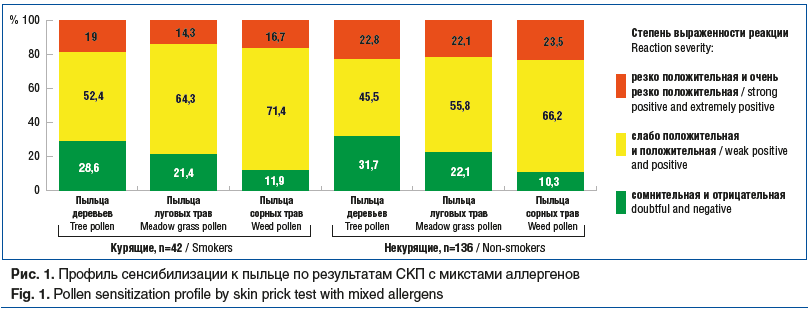
SPT was performed in 42 smokers and 136 non-smokers. Pollen sensitization was detected in more than 80% of smokers and 76–78% of non-smokers (see Fig. 1). Strongly positive SPT for tree pollen was more common in both groups. No significant differences were reported between smokers and non-smokers in the severity of sensitization to tree pollen mixture (p = 0.573, χ2), meadow grass pollen mixture (p = 0.743, χ2), and weed pollen mixture (p = 0.584, χ2).
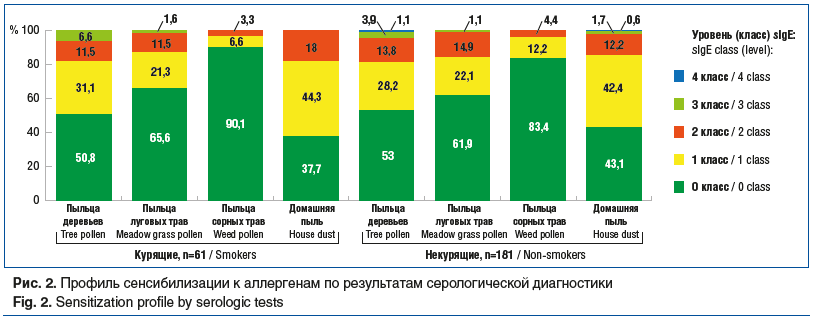
Serum sIgE levels were measured in 61 smokers and 181 non-smokers. In both groups, the levels of sIgE against tree pollen and house dust mites increased (see Fig. 2). No significant differences between smokers and non-smokers in the levels of sIgE against tree pollen (p=0.778, χ2), meadow grass pollen (p=0.896, χ2), weed pollen (p=0.424, χ2), and house dust mites (p=0.583, χ2) were identified.
Spirometry and the bronchodilator test demonstrated that the average values were within normal ranges. Meanwhile, the average peak expiratory flow rate (PEFR), FEV1/forced vital capacity (FVC), and maximum expiratory flow at 25% (MEF25), 50% (MEF50), and 75% (MEF75) of FVC were higher in non-smokers than in smokers (see Table). To determine the reversibility of bronchial obstruction, the bronchodilation coefficient was calculated on the basis of FEV1. The median was 13% [7; 20] in smokers and 8% [4; 14.5] in non-smokers (p=0.003, Mann–Whitney U test).
The assessment of the relationship between eosinophil count and spirometry parameters revealed a moderate direct relationship with FEV1-based bronchodilation coefficient (R=0.346; p=0.0059) and a moderate inverse relationship with FEV1/FVC (R=-0.318; p= 0.0117) in smokers.
Discussion
The authors’ findings on AR are similar to those of the other authors. Thus, P.J. Bousquet et al. [11] examined 1444 patients (20.8% were smokers and 10.9% formerly were smokers) and found that smoking did not promote the development of AR and did not lead to differences in the severity of nasal symptoms. Smoking is associated with a higher prevalence of chronic non-allergic rhinitis and a lower prevalence of AR. However, this phenomenon has been established only in men [12]. Meanwhile, T. Songnuy et al. [13] demonstrated that exposure to tobacco smoke contributes to AR exacerbations. Therefore, both changes in the severity of nasal symptoms and treatment for disease exacerbation in smokers should be evaluated, given the effect of smoking as a trigger of exacerbations.
Many studies have demonstrated that cigarette smoking is a risk factor for asthma in adults with AR [14, 15]. We report the predominance of asthma among young male smokers (p=0.043). Therefore, it is useful to analyze the rate and duration of exacerbations and the use of medications to relieve asthma symptoms in smokers and non-smokers.
Measurements of sIgE and SPT are key diagnostic tools for establishing sensitization to allergens. They provide additional but not identical data, as observed in our study. Allergy test results depend on gender, age, and asthma severity. Thus, H.R. Mohammad et al. [16] demonstrated that the strength of the association between skin tests and the clinical presentation of asthma increases with age. Meanwhile, the contrary pattern is typical for sIgE. E.J Kim et al. [17] reported that the total IgE level is higher in men than in women. However, total IgE levels cannot be considered a reliable allergy marker. Total IgE levels in the blood serum largely depend on age and tend to increase until the age of 15 years, decreasing from the 2nd to the 8th decade of life. Total IgE levels significantly above the reference values are usually associated with atopic disorders, but they may also be associated with other conditions. Thus, an increase in total IgE levels in the blood serum is observed in some smokers [18]. Total IgE levels should be carefully interpreted because low or normal values do not rule out IgE-mediated diseases [18]. In our study, standardization by gender excluded the effect of this factor on allergy test results. We did not find any differences in total IgE levels between young male smokers and non-smokers but found a relationship between total IgE levels in the blood serum and eosinophil count in smokers. R.M. Kumar et al. [19] demonstrated a positive correlation between eosinophil count and total IgE levels in the blood serum of patients with severe persistent asthma. However, the authors failed to assess the effect of smoking on total IgE levels in the blood serum of patients with various asthma severities because of the lack of smokers. No patients with severe persistent asthma were enrolled in this study.
No differences in sensitization to pollen and house dust mites between smokers and non-smokers were identified by allergy tests. C.E. Ciaccio et al. [20] failed to show any significant effects of tobacco on sensitization when studying the combined effects of tobacco smoke and indoor allergens in children. R.M. Gómez et al. [21] demonstrated that serum levels of total IgE and sensitivity to allergens confirmed by skin tests were similar in smokers and non-smokers with AR. Meanwhile, Y.S. Kim et al. [22] found an association between smoking and increased levels of total IgE and sIgE against house dust mites (Dermatophagoides farinae) and cockroaches. The levels of total IgE and sIgE against these allergens increased in proportion to the increase in the number of cigarettes smoked per day. M. Jackson et al. [23] showed that serum levels of total IgE in EC users are significantly higher than those in non-smokers.

The eosinophil count is a promising and easily measured marker of eosinophilic airway inflammation. Eosinophilia is an important risk factor for impaired respiratory function (as in this study). In young smokers, eosinophil count was positively correlated with the FEV1-based bronchodilation coefficient and negatively correlated with FEV1/FVC. H. Backman et al. [24] demonstrated an independent association between increased eosinophil count and reduced FEV1 in adults with asthma. R.J. Hancox et al. [25] found that the eosinophil count is higher in smokers than in non-smokers. In addition, increased eosinophil count correlates with a reduction in FEV1/FVC and FEV1 [25]. However, we found no differences in the eosinophil count between young smokers and non-smokers.
Conclusions
No significant differences in the severity of AR and asthma, sensitization to pollen and house dust mites, peripheral blood eosinophil counts, and total serum IgE levels were identified between young smokers and non-smokers. Allergic asthma is more common in smokers. Latent bronchospasm was detected in smokers with normal baseline spirometry values after the bronchodilator test. In non-smokers, FEV1 did not exceed the natural variability estimates. A moderate direct relationship between eosinophil count and FEV1-based bronchodilation coefficient was observed in smokers.
About the authors:
Elizaveta A. Devyatkova — postgraduate student of the Department of Pediatrics with the Course of Polyclinical Pediatrics, Academician E.A. Vagner Perm State Medical University; 26, Petropavlovskaya str., Perm, 614990, Russian Federation; ORCID iD 0000-0003-4754-2862.
Nataliya V. Minaeva — Dr. Sc. (Med.), professor of the Department of Pediatrics with the Course of Polyclinical Pediatrics, Academician E.A. Vagner Perm State Medical University; 26, Petropavlovskaya str., Perm, 614990, Russian Federation; ORCID iD 0000-0002-2573-9173.
Mariya V. Tarasova — C. Sc. (Med.), chief freelance allergist and immunologist, Head of the Department of Allergy and Immunology, Perm Regional City Hospital; 51, Lenin str., Perm, 614006, Russian Federation; ORCID iD 0000-0002-5237-9863.
Valeriy S. Shelud'ko — C. Sc. (Med.), leading researcher of the Central Research Laboratory, Academician E.A. Vagner Perm State Medical University; 26, Petropavlovskaya str., Perm, 614990, Russian Federation; ORCID iD 0000-0002-7080-9142.
Ekaterina Yu. Plotnikova — Dr. Sc. (Med.), Professor, professor of the Department of Polyclinic Therapy, Postgraduate Training for Doctors and Nursing, Head of the Course of Clini-cal Gastroenterology, Kemerovo State Medical University; 22A, Voroshilov str., Kemerovo, 650029, Russian Federation; Scientific Director of the Kuzbass Regional Hepatological Center, M.A. Podgorbunskiy Kuzbass Clinical Hospital for Emergency Medical Aid; 22, N. Ostrovskiy str., Kemerovo, 650000, Russian Federation; ORCID iD 0000-0002-6150-1808.
Contact information: Elizaveta A. Devyatkova, e-mail: lizadev94@gmail.com.
Financial Disclosure: no authors have a financial or property interest in any material or method mentioned.
There is no conflict of interest.
Received 05.04.2023.
Revised 28.04.2023.
Accepted 26.05.2023.
2. Chuchalin A.G., Khaltaev N., Antonov N.S. et al. Chronic respiratory diseases and risk factors in 12 regions of the Russian Federation. Int J Chron Obstruct Pulmon Dis. 2014;9:963–974. DOI: 10.2147/COPD.S67283. PMID: 25246783.
3. Strzelak A., Ratajczak A., Adamiec A., Feleszko W. Tobacco Smoke Induces and Alters Immune Responses in the Lung Triggering Inflammation, Allergy, Asthma and Other Lung Diseases: A Mechanistic Review. Int J Environ Res Public Health. 2018;15(5):1033. DOI: 10.3390/ijerph15051033.
4. Montaño-Velázquez B.B., Flores-Rojas E.B., García-Vázquez F.J. et al. Effect of cigarette smoke on counts of immunoreactive cells to eotaxin-1 and eosinophils on the nasal mucosa in young patients with perennial allergic rhinitis. Braz J Otorhinolaryngol. 2017;83(4):420–425. DOI: 10.1016/j.bjorl.2016.04.011.
5. Ненашева Н.М. Бронхиальная астма и курение. Эффективная фармакотерапия. 2013;10(1):4–14. [Nenasheva N.M. Bronchial asthma and smoking. Effective Pharmacotherapy. 2013;10(1):4–14 (in Russ.)].
6. Салагай О.О., Антонов Н.С., Сахарова Г.М. Электронные системы доставки никотина и нагревания табака (электронные сигареты): обзор литературы. Наркология. 2019;18(9):77–100. DOI: 10.25557/1682-8313.2019.09.77-100. [Salagay O.O., Antonov N.S., Sakharova G.M. Electronic nicotine delivery and tobacco heating systems (electronic cigarettes): a review of the literature. Narcology. 2019;18(9):77–100 (in Russ.)]. DOI: 10.25557/1682-8313.2019.09.77-100.
7. Shargorodsky J., Garcia-Esquinas E., Navas-Acien A., Lin S.Y. Allergic sensitization, rhinitis, and tobacco smoke exposure in U.S. children and adolescents. Int Forum Allergy Rhinol. 2015;5(6):471–476. DOI: 10.1002/alr.21444. PMID: 25884913.
8. Feleszko W., Ruszczyński M., Jaworska J. et al. Environmental tobacco smoke exposure and risk of allergic sensitisation in children: a systematic review and meta-analysis. Arch Dis Child. 2014;99(11):985–992. DOI: 10.1136/archdischild-2013-305444.
9. Афифи Ф. Статистический анализ: подход с использованием ЭВМ. М.: Мир; 1982. [Afifi F. Statistical analysis: a computer-assisted approach. M.: Mir; 1982 (in Russ.)].
10. Шелудько В.С., Девяткова Г.И. Теоретические основы медицинской статистики (статистические методы обработки и анализа материалов научно-исследовательских работ: учеб.-метод. пособие. Пермь: ФГБОУ ВО ПГМУ им. академика Е.А. Вагнера Минздрава России; Саратов: Амирит; 2019. [Sheludko V.S., Devyatkova G.I. Theoretical foundations of medical statistics (statistical methods of processing and analysis of research materials: textbook.- method. stipend. Perm: Academician E.A. Vagner Perm State Medical University; Saratov: Amirit; 2019 (in Russ.)].
11. Bousquet P.J., Cropet C., Klossek J.M. et al. Effect of smoking on symptoms of allergic rhinitis. Ann Allergy Asthma Immunol. 2009;103(3):195–200. DOI: 10.1016/S1081-1206(10)60181-0.
12. Eriksson J., Ekerljung L., Sundblad B.M. et al. Cigarette smoking is associated with high prevalence of chronic rhinitis and low prevalence of allergic rhinitis in men. Allergy. 2013;68(3):347–354. DOI: 10.1111/all.12095.
13. Songnuy T., Scholand S.J., Panprayoon S. Effects of Tobacco Smoke on Aeroallergen Sensitization and Clinical Severity among University Students and Staff with Allergic Rhinitis. J Environ Public Health. 2020;2020:1692930. DOI: 10.1155/2020/1692930.
14. Eguiluz-Gracia I., Mathioudakis A.G., Bartel S. et al. The need for clean air: The way air pollution and climate change affect allergic rhinitis and asthma. Allergy. 2020;75(9):2170–2184. DOI: 10.1111/all.14177.
15. Bédard A., Sofiev M., Arnavielhe S. et al. Interactions Between Air Pollution and Pollen Season for Rhinitis Using Mobile Technology: A MASK-POLLAR Study. J Allergy Clin Immunol Pract. 2020;8(3):1063–1073.e4. DOI: 10.1016/j.jaip.2019.11.022.
16. Mohammad H.R., Belgrave D., Kopec Harding K. et al. Age, sex and the association between skin test responses and IgE titres with asthma. Pediatr Allergy Immunol. 2016;27(3):313–319. DOI: 10.1111/pai.12534.
17. Kim E.J., Kwon J.W., Lim Y.M. et al. Assessment of Total/Specific IgE Levels Against 7 Inhalant Allergens in Children Aged 3 to 6 Years in Seoul, Korea. Allergy Asthma Immunol Res. 2013;5(3):162–169. DOI: 10.4168/aair.2013.5.3.162.
18. Ansotegui I.J., Melioli G., Canonica G.W. et al. IgE allergy diagnostics and other relevant tests in allergy, a World Allergy Organization position paper. World Allergy Organ J. 2020;13(2):100080. DOI: 10.1016/j.waojou.2019.100080.
19. Kumar R.M., Pajanivel R., Koteeswaran G. et al. Correlation of total serum immunoglobulin E level, sputum, and peripheral eosinophil count in assessing the clinical severity in bronchial asthma. Lung India. 2017;34(3):256–261. DOI: 10.4103/lungindia.lungindia_73_16.
20. Ciaccio C.E., DiDonna A.C., Kennedy K. et al. Association of tobacco smoke exposure and atopic sensitization. Ann Allergy Asthma Immunol. 2013;111(5):387–390. DOI: 10.1016/j.anai.2013.07.023.
21. Gómez R.M., Croce V.H., Zernotti M.E., Muiño J.C. Active smoking effect in allergic rhinitis. World Allergy Organ J. 2021;14(2):100504. DOI: 10.1016/j.waojou.2020.100504.
22. Kim Y.S., Kim H.Y., Ahn H.S. et al. The Association between Tobacco Smoke and Serum Immunoglobulin E Levels in Korean Adults. Intern Med. 2017;56(19):2571–2577. DOI: 10.2169/internalmedicine.8737-16.
23. Jackson M., Singh K.P., Lamb T. et al. Flavor Preference and Systemic Immunoglobulin Responses in E-Cigarette Users and Waterpipe and Tobacco Smokers: A Pilot Study. Int J Environ Res Public Health. 2020;17(2):640. DOI: 10.3390/ijerph17020640.
24. Backman H., Lindberg A., Hedman L. et al. FEV1 decline in relation to blood eosinophils and neutrophils in a population-based asthma cohort. World Allergy Organ J. 2020;13(3):100110. DOI: 10.1016/j.waojou.2020.100110.
25. Hancox R.J., Pavord I.D., Sears M.R. Associations between blood eosinophils and decline in lung function among adults with and without asthma. Eur Respir J. 2018;51(4):1702536. DOI: 10.1183/13993003.02536-2017.

This work is licensed under a Creative Commons «Attribution» 4.0 License.
