Sensitization to epidermal allergens in children with allergic disorders: a 30-year follow-up study




















DOI: 10.32364/2587-6821-2024-8-3-1
S.I. Bardenikova1, E.E. Lokshina1, O.B. Dovgun2, L.A. Shavlokhova1, N.A. Bogdanova1, N.B. Serebrovskaya1, S.A. Mstislavskaya1, G.B. Kuznetsov1
1Russian University of Medicine, Moscow, Russian Federation
2St. Vladimir Children's City Clinical Hospital, Moscow, Russian Federation
Aim: to analyze changes in sensitization to common epidermal allergens over time in children with allergic diseases in a metropolitan area.
Patients and Methods: summary and analysis of 26,343 skin prick test protocols of children aged 4–18 years who were examined and treated between 1989 and 2019 were performed. A standard skin scarification test was used to determine an individual's sensitivity to common epidermal allergens, including feline, canine, sheep, and equine hair/epidermis, pillow feathers, and human hair, using a drop of water-salt allergen extract. To calculate the average exponents, i.e., the annual level and severity of sensitization, visual scoring (+1, +2, +3, +4) was used. This was done by calculating the percentage ratio of the number of patients with hypersensitivity to the allergen to the total number of patients examined for this allergen during a particular year. The proportion of low (1-2) and high (3-4) scores were also compared.
Results: the cohort of allergic children was followed up for 30 years, during which there was a constant increase in IgE-hypersensitivity to epidermal allergens. Specifically, there was an 8.5-fold increase in sensitivity to feline hair/epidermis, with a 27.5-fold increase in the proportion of children scoring 3–4 points. Sensitivity to canine hair/epidermis increased by 5.2 times, while sensitivity to horse dander increased by 24%, sheep's hair by 23.7%, pillow feather by 2.7 times, and human hair by 2.8 times. Meanwhile, a retrospective analysis has shown a slowdown in the rate of increase in the number of sensitized patients and a decrease in the severity of specific hypersensitivity, mainly in the range of 1–2 points, over the last 15 years.
Conclusion: the retrospective analysis indicates a progressive increase in epidermal sensitization to all studied allergens, with a general increase in the severity of hypersensitivity. This suggests an increase in close direct and indirect contacts with animals, as well as the potential effect of aggressive urban ecology on the immune balance of a growing child and the transformation of immunogenicity of animal allergens themselves. Given this, it is important to consider the efficacy of elimination measures and the choice of effective methods for preventing epidermal allergy. This includes the formation of immune tolerance to ensure reliable and long-term protection.
Keywords: animal allergens, epidermal allergy, children, sensitization monitoring, increased hypersensitivity; perspectives.
For citation: Bardenikova S.I., Lokshina E.E., Dovgun O.B., Shavlokhova L.A., Bogdanova N.A., Serebrovskaya N.B., Mstislavskaya S.A., Kuznetsov G.B. Sensitization to epidermal allergens in children with allergic disorders: a 30-year follow-up study. Russian Medical Inquiry. 2024;8(3):118–123 (in Russ.). DOI: 10.32364/2587-6821-2024-8-3-1.
Background
Since ancient times, there has been a close relationship between humans and animals. In fact, the latter appeared on Earth much earlier than the human race. The animal world is multifaceted, and the history of relations between animals and humans is multiplex. This includes wild and tame animals, those living in human dwellings and backyards. It also includes small rodents that are "illegally" living in houses. A child's interactions with the animal kingdom commence before birth and persist throughout their lifespan. These interactions may be domestic or professional, overt or covert, permanent or transient, and may be close or fleeting. It is evident that urbanization has profound implications for these interactions, rendering them at times obligatory, inevitable, intimate, and enduring.
Epidermal allergens are diverse and pervasive in the human environment, exerting potent stimulatory effects on allergic responses. Significant advancements have been made in the identification of animal allergens, and the carriers/producers are well studied. These include the epidermis/dandruff, hair, feathers, and excreta (sweat, urine, feces, and saliva) [1, 4, 7]. Contact with these allergens is possible through direct contact with animals themselves, objects contaminated with native excreta, leather, fur, and wool products, cosmetic (shampoos, perfumes, creams, and powders) and therapeutic (ointments, suppositories) products containing potentially reactive animal components. In addition, specific epidermal aeroallergens are found in the air and dust of locations where animals are kept (e.g., houses, apartments, open aviaries, livestock yards) and are easily transported in space. Finally, these unique allergens are presented in foods of animal origin (e.g., raw milk, raw meat, or semi-finished products) [1, 5, 8]. Meanwhile, modern children, similar to adults, have an "office" lifestyle, spending 90% of the day in a closed, poorly ventilated space (house, kindergarten, school) with a potentially high concentration of various household allergens [1]. The immune response and initiating threshold concentrations of these allergens are highly individualized, and hyperimmune response is unpredictable and certainly associated with hereditary predisposition [3, 6]. The immunomodulatory effect of epidermal allergens on the developing organism is of practical interest [9, 10]. In childhood, clinical syndromes of animal allergy are more often mediated by immediate hypersensitivity reactions and manifest themselves as allergic rhinitis, allergic conjunctivitis, and asthma. Insidious anaphylactic reactions are also possible [1, 11]. Allergy tests that determine specific sensitization are an important method of verifying the diagnosis of epidermal allergy, in conjunction with a clinical and epidemiological history. In general, sensitization to animal allergens is now registered in almost one-third of the human population, and its extent is increasing in heterogeneous populations. In this context, the underestimation of the significance of constant exposure to animal allergens by both patients and physicians is a significant concern. Moreover, it is of paramount importance that those with expertise in different fields pay close attention to sensitization to epidermal allergens. This is because the relevance of epidermal allergy is clear and it is an important issue of general medicine.
The aim of this study is to analyze the changes in sensitization to common epidermal allergens over time in children with allergic diseases in a metropolitan area.
Patients and Methods
A retrospective analysis was conducted on the results of 26,343 scarification tests performed on children aged 4-18 years with asthma, allergic rhinitis, allergic conjunctivitis, pollinosis, and atopic dermatitis who were examined and treated in the Pulmonology Department between 1989 and 2019.
Specific hypersensitivity to common epidermal allergens (hair/epidermis of cat, dog, sheep, rabbit, guinea pig, and horse, pillow feather, and human hair) was determined by skin tests according to the generally accepted technique of scarification using a drop of allergen with subsequent visual semi-quantitative evaluation in "crosses"/points from 1 to 4. Diagnostic water-salt allergen extracts from tested animals were utilized (JSC "Biomed", Russia). The volume of archival data was summarized and processed for all years of the time series. The following exponents were employed as dynamic comparison tools: sensitization level (percentage ratio of the number of patients sensitized to the studied allergen to the sum of patients examined for hypersensitivity in a particular year) and sensitization level (ratio of the percentages of patients with low- (1 and 2 points) and high-level (3 and 4 points) hypersensitivity). To illustrate the principal trends in the evolution of parameters over time, time series were grouped, shortened, and presented in a condensed format. For the sake of clarity, the data were presented in a "cross-section" of the initial, final, and median years of the follow-up period. Diagrams were employed, including bar charts displaying the average annual (percentage) values of different levels of hypersensitivity (ranging from 1 to 4 points) and pie charts illustrating the ratio of the number of children unsensitized to those sensitized.
Results and Discussion
Figures 1 and 2 demonstrate a clear increase in the prevalence of cat hair/epidermis sensitization over time, accompanied by a corresponding rise in the number of hypersensitive children. By 2019, the cumulative number of hypersensitive children had increased by 53.6% (8.5 times) compared to 1989, while the prevalence of high-level sensitization (3-4 points) had risen by 27.5 times over the same period. Furthermore, the prevalence of high-level sensitization (3-4 points) has increased by 27.5 times over the past 30 years. In contrast, the rapid growth rate observed in the 1990s and 2000s has been replaced by a slow increase in low-level sensitization over the past 15 years, with these values remaining stable. These parameters of the prevalence of specific hypersensitivity are consistent with other Russian studies, which have reported rates of 57.3% for cat allergens and 30% for dog allergens [13].
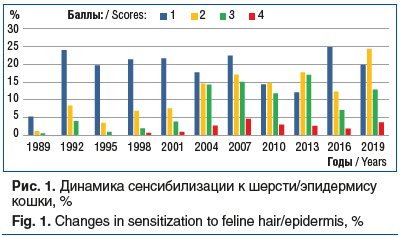
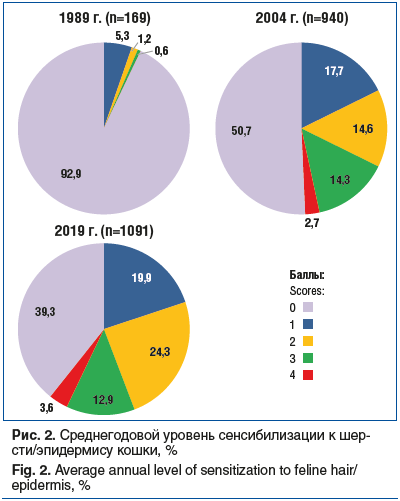
Figure 3 illustrates the gradual increase in the proportion of children sensitized to dog hair/epidermis over time. By 2019, 37.7% of children exhibited sensitization, a significant rise from 7.7% in 1989. This increase was largely attributed to low-level hypersensitivity, defined as a score of 1-2 points. Consequently, a 30% (or 5.2-fold) increase was observed over the entire 30-year follow-up period. These patterns indicate a strong correlation between the calculated exponents and changing conditions of animal keeping. Thus, in Moscow, the private residential sector is too limited in size, and dogs reside in apartments in close proximity to their owners. Concurrently, the expansion of sensitization to dog allergens may be partially cross-sensitized due to the growing hypersensitivity to cat allergens [7].
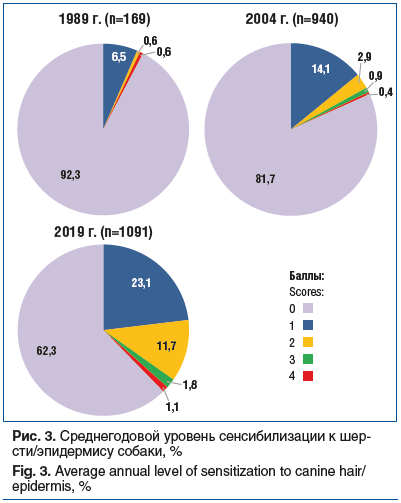
Fig. 4 illustrates a 24% increase in the number of children hypersensitive to horse dander over a 30-year period, attributable to an increase in low- and high-level sensitization. It is noteworthy that the mean value of sensitization over the past 15 years has remained relatively stable (67.8% in 2004 and 68.8% in 2019), yet the registration of high-level hypersensitivity has increased by 1.7 times. This phenomenon within our metropolis may be indicative of the increasing accessibility of children to these graceful animals in various equestrian sports, popular entertainment (in the park, "Durov's Corner," zoo), and rehabilitation hippotherapy. But it cannot be ruled out that a significant contribution to the development of allergies to horses, cats, and dogs may be attributed to cross-sensitization between their allergens (between animal serum albumin or some lipocalin allergens, such as feline Fel d 4, equine Equ c 1, and canine Can f 6) [3, 7].
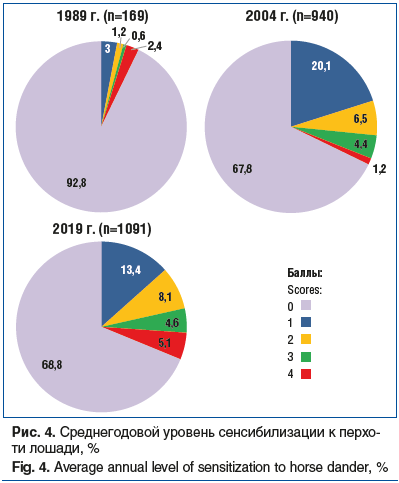
Fig. 5 illustrates the changes in sensitization to sheep wool over time. The number of sensitized children has consistently increased, from 8.9% in 1989 to 32.6% in 2019, representing an overall increase of 23.7%. It is noteworthy that 30 years ago, only low-level sensitization (1 point) was observed, whereas today, both low- and high-level hypersensitivity have been identified. Given the potential rarity of direct communication of urban children with these animals, it is logical to assume that contact with tanned fur and dyed wool in bedding accessories and clothing may be a possible cause of hypersensitization. It is anticipated that the quality of raw material processing has improved over time, resulting in the reduction of residual amounts of specific allergens in items and their allergenicity to an absolute minimum. Consequently, the cause of the observed increase in hypersensitivity may be attributed to both hyperactivity of the immune system, which may be perceived as an "exceeding of the powers of adequate defense" against classical natural allergens, and the triggering effect of chemical reagents and textile dyes.
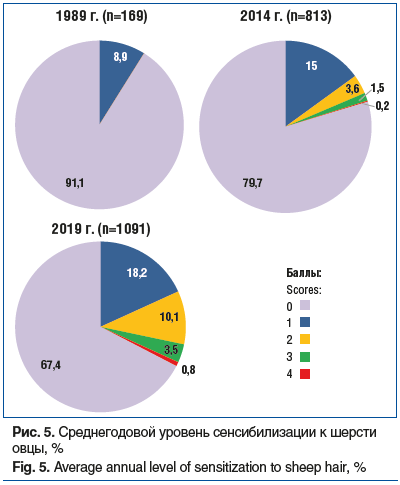
Fig. 6 illustrates the changes in sensitization to human hair. This test was a standard component of the diagnostic allergy panel until 2004. The data indicates a marked increase in the prevalence of hypersensitivity to human hair allergens, rising from 10% in 1989 to 65% in 1999. This is in stark contrast to the situation in 1989, when only 10% of children exhibited this allergy. It is challenging to elucidate the "candle" phenomenon observed in the annual monitoring of this allergen. However, in light of the social issues that arose during the period of historical perestroika in Russia in the 1990s, it is possible that the observed increase in sensitization to human hair in allergic patients was due to a combination of factors. These include changes in the reactivity of allergenic hair molecules in response to poor-quality nutrition, external ecology, and aggressive substandard care products. Additionally, imperfect quality and standardization of diagnostic test reagents may have contributed to the observed phenomenon. In 2004, the total number of individuals sensitized to this allergen was 28.1% (hypersensitivity score was 1 point in most individuals examined), representing a 2.8-fold increase compared to 1989.
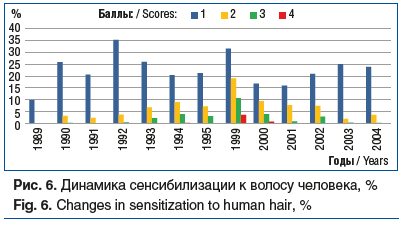
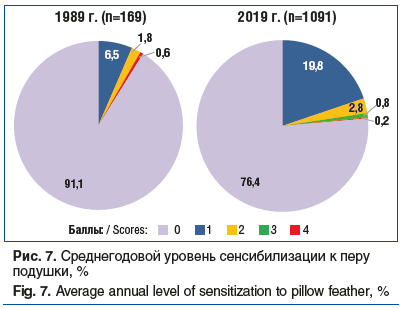
Fig. 7 illustrates the changes in sensitization to cushion feather. The average rate of this phenomenon was 8.9% in 1989 and stabilized by 2019, being 2.7 times higher than in 1989. A notable peak in the rate of dynamic growth of the level of this specific hyperreactivity was observed in 1995. Currently, the prevalence of detectable levels of sensitization to cushion feather allergen remains stable, accounting for 23.6% of all allergies in children (predominantly low-level sensitization). It appears that the desired outcome was the result of a number of regularities. Firstly, the contemporary cohort of allergic children residing in urban areas has limited direct contact with farm and urban birds. Secondly, the replacement of an allergic child's bedding with synthetic fabrics and fillers, regulated by hypoallergenic household products, proved to be an effective solution. Consequently, the grandmother's century-old featherbeds and pillows were finally removed from the maternity home. Third, the fashion industry has also made a beneficial contribution to medicine, with the replacement of natural winter down jackets with practical clothes with artificial insulators.
Conclusions
This study presents the findings of a 30-year observational study, which demonstrate a consistent and gradual increase in epidermal sensitization in children with allergic diseases, with a corresponding rise in hypersensitivity levels, regardless of the allergen under investigation. In children with allergic disease, the most common allergens are those associated with cats. Over a 30-year follow-up period, sensitization to cat allergens increased by 8.5 times, with an unprecedented 27.5-fold increase in high-level sensitization. In metropolitan areas, this phenomenon serves to illustrate the "exposure density" of specific allergens, particularly those of domestic pets. However, it is crucial to recognize that two interacting components are equally responsible for the development of allergic diseases: the animal, which produces potentially highly reactive specific proteins as part of its natural excreta, and the human immune system, which initiates an inadequately strong response to contact with epidermal allergens. Both interacting subjects are situated within a shared zone of active pressure from aggressive environmental stimuli within the residence. It is evident that the progressive rise in sensitization to animal allergens in Russia during the 1990s was the result of a fatal maladaptation of the easily vulnerable immunity of a growing child, which was influenced by a number of factors, including global socioeconomic issues, unbalanced nutrition, and uncontrolled ecology. The same unfavorable factors simultaneously affected the health of animals, resulting in alterations to the reactivity of specific allergenic molecules. The initial national program for the treatment and prevention of allergies, entitled "Asthma in Children. The "Treatment Strategy and Prevention," which recommended the complete elimination of potential allergens and triggers from the patient's controlled environment, demonstrated a significant protective effect. However, the new, slow and continuous increase in epidermal sensitization registered since the 2000s is more likely to illustrate progressive immune dysfunction than exposure to aggressive allergens. It is also important to consider the potential impact of the quality of widely used diagnostic natural extracts of epidermal allergens on the detection of high-level allergy tests. These extracts are difficult to standardize and contain not only a marker allergen but also cross-reactive molecules, which can lead to an overestimation of sensitization to a particular animal. Furthermore, the technique of skin testing is inherently subjective, as it relies on visual assessment and interpretation of scarification tests. In our study, high-level sensitization was observed in a cohort of children with established allergies, which is naturally higher than in the general population, as reported by the Global Allergy and Asthma European Network/GA2LEN (ranging from 10% to 27%). Meanwhile, some countries with cold climates have reported a similar increase in epidermal hypersensitivity. For instance, in Denmark, the prevalence of epidermal hypersensitivity in dogs and cats was 56% and 49.3%, respectively [7].
Consequently, screening for epidermal hypersensitivity represents a valuable and highly informative tool that is readily available in routine practice. It allows for the analysis of the prevalence and clinical significance of this type of household sensitization, the identification of risks and prognosis, and the timely development and implementation of therapeutic intervention strategies in the form of adequate anti-epidemic measures, rational specific and nonspecific prophylaxis to prevent early, “insidious” polysensitization [12].ABOUT THE AUTHORS:
Svetlana I. Bardenikova — C. Sc. (Med.), associate professor of the Department of Pediatrics; Russian University of Medicine; 4, Dolgorukovskaya str., Moscow, 127006, Russian Federation; ORCID iD 0000-0002-3428-0843.
Evelina E. Lokshina — C. Sc. (Med.), professor of the Department of Pediatrics; Russian University of Medicine; 4, Dolgorukovskaya str., Moscow, 127006, Russian Federation; ORCID iD 0000-0001-6006-7846.
Oksana B. Dovgun — C. Sc. (Med.), Associate Professor, Head of the Department of Pulmonology, St. Vladimir Children's City Clinical Hospital; 1/3, Rubtsovsko-Dvortsovaya str., Moscow, 107014, Russian Federation; ORCID iD 0000-0001-6306-1546.
Larisa A. Shavlokhova — C. Sc. (Med.), associate professor of the Department of Pediatrics; Russian University of Medicine; 4, Dolgorukovskaya str., Moscow, 127006, Russian Federation.
Natalya A. Bogdanova — C. Sc. (Med.), associate professor of the Department of Pediatrics; Russian University of Medicine; 4, Dolgorukovskaya str., Moscow, 127006, Russian Federation.
Nadezhda B. Serebrovskaya — C. Sc. (Med.), associate professor of the Department of Pediatrics; Russian University of Medicine; 4, Dolgorukovskaya str., Moscow, 127006, Russian Federation.
Sofya A. Mstislavskaya — C. Sc. (Med.), associate professor of the Department of Pediatrics; Russian University of Medicine; 4, Dolgorukovskaya str., Moscow, 127006, Russian Federation.
Georgiy B. Kuznetsov — C. Sc. (Med.), associate professor of the Department of Pediatrics; Russian University of Medicine; 4, Dolgorukovskaya str., Moscow, 127006, Russian Federation.
Contact information: Svetlana I. Bardenikova, е-mail: s_bard@bk.ru.
Financial Disclosure: no authors have a financial or property interest in any material or method mentioned.
There is no conflict of interest.
Received 11.03.2023.
Revised 04.04.2023.
Accepted 27.04.2023.

This work is licensed under a Creative Commons «Attribution» 4.0 License.

