
POEMS-syndrome with the disease onset in the form of сhronic dysimmune neuropathy
DOI: 10.32364/2587-6821-2022-6-10-589-595
V.V. Korotaeva, Ya.B. Kushnir, O.V. Kudyasheva, A.Yu. Polushin, V.S. Krasnov
I.P. Pavlov First St. Petersburg State Medical University, St. Petersburg, Russian Federation
POEMS syndrome (Polyneuropathy, Organomegaly, Endocrinopathy, M-protein, Skin changes) is a rare paraneoplastic disease associated with plasma cell dyscrasias, the pathogenesis of which is currently not fully understood. The diagnosis of POEMS syndrome is commonly confirmed after an extended period of time from the disease onset, since the syndrome is rare and can be mistaken for other neurological diseases, for instance, chronic inflammatory demyelinating polyneuropathy (CIDP). The article describes a clinical case of the disease in a young male patient with the onset of neurological disorders in the form of the CIDP clinical phenotype, refractory to first-line therapy, and further systemic clinical and laboratory comorbidities of POEMS syndrome. The necessary laboratory and radiological studies were performed to confirm the diagnosis. The diagnosis was established based on the presence of 2 major, 1 additional major and 4 minor criteria of POEMS syndrome in the pati ent. Then the patient was discharged for further observation of hematologists to initiate basic therapy of POEMS syndrome. Early detection of the POEMS syndrome "red flags" in patients with the CIDP allows for timely treatment initiation, prevention of further disease progression and the development of persistent disabling disorders.
Keywords: POEMS-syndrome, chronic inflammatory demyelinating polyneuropathy, paraprotein, monoclonal gammopathy of undetermined significance.
For citation: Korotaeva V.V., Kushnir Ya.B., Kudyasheva O.V. et al. POEMS-syndrome with the disease onset in the form of сhronic dysimmune neuropathy. Russian Medical Inquiry. 2022;6(10):589–595 (in Russ.). DOI: 10.32364/2587-6821-2022-6-10-589-595.
Background
POEMS (Polyneuropathy, Organomegaly, Endocrinopathy, Monoclonal Gammopathy, Skin changes) syndrome belongs to the paraneoplastic syndromes arising from the primary tumor lesion of plasma cells in the bone marrow [1]. The pathogenesis of POEMS is currently not fully understood. Overproduction of proinflammatory cytokines (in particular, vascular endothelial growth factor/VEGF) is hypothesized to be triggered in the bone marrow because of plasma cell dyscrasia. VEGF, a multifunctional cytokine, is responsible for angiogenesis and increases vascular permeability. VEGF levels are often significantly higher in POEMS than in other hematological diseases and inflammatory polyneuropathies [2]. POEMS is a rare disease (according to published data, 3 per 1 million). Disease onset usually occurs during a patient's 40s to 60s and is slightly more common in men [1, 3].
The diagnostic criteria for POEMS were developed by A. Dispenzieri et al. from the Mayo Clinic [1]. Meanwhile, this diagnosis is difficult for a neurologist in the clinical setting. Polyneuropathy with demyelination pattern as demonstrated by electroneuromyography (ENMG) may be mistaken for chronic inflammatory demyelinating polyneuropathy (CIDP). Paraprotein levels are often increased insignificantly and, therefore, overlooked, while systemic signs are accounted for by unrelated comorbidities [4]. Neurological manifestations do not always occur at disease onset. POEMS most often manifests with systemic and lab signs, and patients refer to hematologists who determine treatment strategy.
A specificity of this case report is that neurological manifestations preceded systemic and lab signs by eight months, which delayed timely diagnosis and treatment.
Case report
A 36-year-old man was admitted to the Department of Neurology in April 2021. At admission, the patient complained of stabbing foot and toe pain, weakness in legs (impossibility of active movements and walking), and weakness in arms, mostly in hands (impossibility of active hand and elbow joint movements).
The first signs of the disease (paresthesia, dysesthesia, and severe neuropathic foot pain) emerged in February 2020. A month after disease onset, the patient complained of distal lower limb weakness. Distal and proximal lower limb weakness progressed for 6 months after onset. Hand weakness appeared after 7 months. By month 10, leg and hand weakness had progressed to paralysis. Moreover, proximal upper limb weakness emerged. Since the disease onset, weight loss was 60 kg.
Two months after disease onset, the patient underwent ENMG of the upper and lower limbs that has showed demyelination and secondary axon degeneration. ENMG performed at month 13 has showed electrical silence of the lower limb muscles. Ten months after disease onset, chest, abdominal, and pelvic CT revealed hyperplasia of few intrathoracic, iliac, and inguinal lymph nodes and hepatosplenomegaly.
From month 4 to month 11, the patient was followed up with a diagnosis of CIDP. He received oral steroids, but no effect was reported. Before admission to the hospital, intravenous immunoglobulin therapy and plasma exchange were not performed.
By the time of admission to the Department of Neurology, disease duration was 14 months. Hyperpigmentation, bronze skin gained the attention. Multiple, pigmented, hyperkeratosis-like spots on the fingers and toes and a single pigmented hyperkeratosis spot in the area of the right greater trochanter were seen. Trophic changes of foot skin and hand and foot leukonychia were detected (see Figs. 1 and 2).
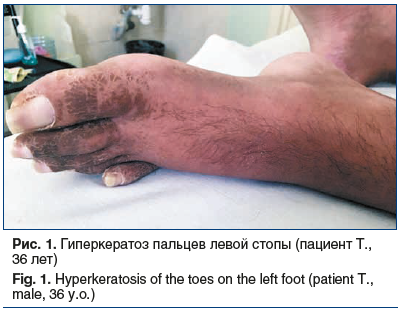
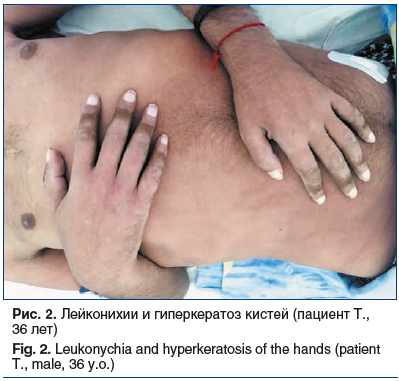
At admission, polyneuritis mostly manifested as severe motor disorders (areflexia of the lower and upper limbs and severe tetraparesis to paraparesis with minimal hand movements) and muscle atrophy were revealed. Severe sensory disorders (stocking-glove anesthesia, stocking hypesthesia, and foot allodynia) were also reported. Severe proprioceptive dysfunction (no vibration sensitivity in the upper limbs from the head of the humerus and in the lower limbs from the patella, no bilateral active joint position sense when moving with hands and feet) was detected. Vegetative disorders included coldness and trophic hand and foot skin changes, persistent lower leg and foot red dermographia. The patient also complained of severe neuropathic pain in his legs unrelieved by therapeutic daily doses of gabapentin (up to 2,400 mg daily), duloxetine (up to 60 mg daily), and carbamazepine (up to 1,200 mg daily).
At admission, patient's condition was assessed using several polyneuropathy scores, i.e., INCAT (Inflammatory Neuropathy Cause and Treatment) disability score for inflammatory neuropathies, I-RODS (Inflammatory Rasch-built Overall Disability Scale) to assess activity and social participation limitations in patients with inflammatory neuropathies, and NIS (Neuropathy Impairment Score). The total INCAT score was 9, I-RODS score 0, and the NIS score 175.5.
Complete blood count (CBC) revealed erythrocytosis (6.96×10¹²/l) and thrombocythemia (550×109/l). Blood biochemistry detected high TSH (6.068 mIU/l), low total protein (57 g/l) and vitamin B12 (103.3 pmol/l). Parameters of the urinalysis and 24-h urine protein test were within normal ranges, Bence-Jones protein was not identified. CSF analysis demonstrated a significantly elevated protein (up to 2,460 mg/l), other parameters were within normal ranges. Biomarkers of connective tissue diseases were also within normal ranges. Capillary electrophoresis of serum proteins revealed an absolute reduction in albumin (28.4 g/l), absolute values of globulins were within normal ranges. Immunoglobulin (Ig) A, M, and G were within normal ranges. High lambda free light chains (up to 13.61 µg/ml) were found in urine aliquot. Meanwhile, serum kappa and lambda light chains were within normal ranges. Serum and urine samples were typed by immunochemistry (IHC). IgG/lambda paraprotein (1.17 g/l) was identified.
Whole-body low-dose CT (WBLDCT) was performed to detect skeletal osteosclerotic and osteolytic lesions. CT revealed a large area of bone rarefaction in the right scapula sized up to 31×16×31 mm with regular sclerotic contour, partial disruption of the cortical layer, and soft tissue component, and an area of bone rarefaction in the right S4 transverse process sized up to 8×15 mm with regular contour (see Fig. 3).
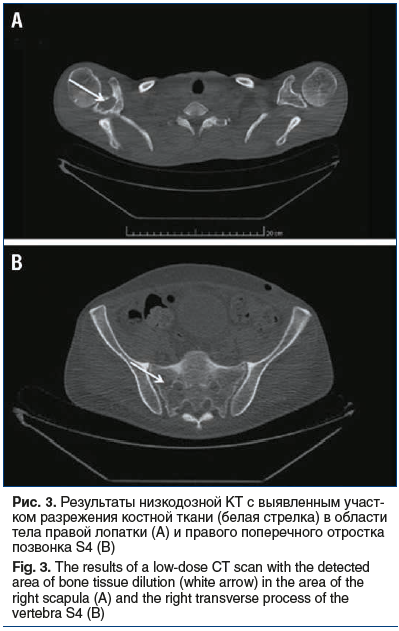
To rule out primary amyloidosis, a biopsy of abdominal subcutaneous adipose tissue was performed and serum β2 microglobulin was measured. Biopsy revealed no signs of amyloid accumulation. The level of β2 microglobulin was 5.18 mg/l (↑).
Given the results of lab and instrumental studies, the patient was referred to the hematologist and underwent bone marrow trephine biopsy. IHC of bone marrow specimens revealed a moderate excess of plasma cells (7–8%) without any signs of monotypic light chain expression.
Clinical presentations, history, and prehospital and hospital examinations are forced to suspect POEMS since two mandatory major criteria, one additional major criterion, and four minor criteria were present.
In collaboration with a hematologist, therapy with lenalidomide was initiated since bortezomib (first-line treatment for POEMS) was contraindicated due to the risk of polyneuropathy progression.
After discharge, the patient was followed up by a hematologist to initiate treatment for POEMS with lenalidomide and dexamethasone.
Three months after starting the specific therapy, the patient reported a positive trend (decrease in the severity of motor deficit and neuropathic pain). Additionally, somatic improvement was also reported (body mass normalization, reduction of hyperpigmentation). The patient starts to specific treatment and is followed up by a hematologist and neurologist.
Discussion
POEMS is of special importance in the diagnosis of inflammatory polyneuropathies. It is easy to establish the diagnosis in advanced clinical presentations. However, when neurological symptoms precede systemic clinical and laboratory manifestations, it is difficult for neurologists to timely suggest POEMS and refer the patient to a hematologist to start a specific treatment. Published data report that POEMS manifestation with neurological symptoms at onset occurs in less than 50% [3].
This case report is interesting because neurological symptoms precede the classic systemic signs of POEMS (hepatosplenomegaly and lymphadenopathy) by nearly 10 months. Notably, specific tests were performed at disease onset to rule out paraproteinemic polyneuropathies. However, lab tests failed to detect any paraprotein production.
Given the lack of evidence for POEMS at disease onset, the patient was diagnosed with typical CIDP based on the 2010 EFNS/PNS criteria. According to published data, misdiagnosis of CIDP in patients with POEMS is common. H.C. Lehmann et al. [5] concluded that patients with POEMS formally fully meet the criteria for true CIDP due to the similarity of clinical presentations and imperfection of current criteria for CIDP. This patient had all clinical signs of typical CIDP, i.e., a) symmetrical proximal and distal muscle weakness and sensory disorders in his arms and legs for at least 2 months, b) chronic progressive disease course, and c) absent tendon reflexes in his arms and legs. Additionally, CSF analysis revealed elevated protein (2,460 mg/l) and cytosis (WBC >10 cells/mm3). ENMG of the upper and lower limbs demonstrated demyelinating picture typical for CIDP [6].
![Таблица. POEMS-синдром: диагностические критерии [1], клинические проявления и их патогенетическое обоснование у пациента Т. Table. POEMS syndrome: diagnostic criteria [1], clinical manifestations and their pathogenetic rationale in patient T.](/upload/medialibrary/5c0/589-4.png "Таблица. POEMS-синдром: диагностические критерии [1], клинические проявления и их патогенетическое обоснование у пациента Т. Table. POEMS syndrome: diagnostic criteria [1], clinical manifestations and their pathogenetic rationale in patient T.")
Some authors suggest that only minor nuances in ENMG picture allow distinguishing between polyneuropathy in POEMS and typical CIDP. POEMS can be suspected by ENMG if demyelination that predominantly affects the nerve trunk but not distal fibers is detected, and more severe axon degeneration in the lower limbs than in the upper limbs [7]. This case report describes a patient with the advanced disease. ENMG shows electrical silence of lower limb muscles (reduction of MEP amplitude to zero), thereby suggesting a significant lower limb nerve injury.
Therefore, immune-mediated neuropathy in POEMS is a disorder hiding behind the mask of CIDP. To suspect early POEMS in a patient with clinical signs of typical CIDP, neurologists should be aware of so-called “red flags.” According to published data, “red flags” for POEMS are severe nerve or muscle pain in the foot or lower leg at disease onset, comorbidities or signs of systemic conditions (e.g., edema, weight loss, organomegaly, hyperpigmentation, rash, gynecomastia), and no response to adequate first-line CIDP therapy.
Moreover, immune-mediated neuropathy in POEMS is characterized by more rapid loss of ability to walk independently than in CIDP (it takes, on average, 9.5 months from disease onset to disability) [8]. This patient complained of severe neuropathic foot pain at disease onset. Moreover, the gradual significant weight loss (60 kg for a year from disease onset) is also noteworthy. At admission, physical examination revealed severe hyperpigmentation and nail discoloration (leukonychia). Despite adequate first-line CIDP therapy (oral methylprednisolone 1 mg/kg/day for 6 months), a rapid and steady increase in neurologic deficit (paralysis of the arms and legs within 10 months from disease onset) was reported.
Therefore, atypical features revealed by careful history taking and physical examination allowed us to suspect POEMS-associated immune-mediated neuropathy. Meanwhile, additional laboratory and instrumental tests were performed to rule out other causes of inflammatory polyneuropathy and to establish POEMS based on its criteria. WBLDCT was performed to reveal osteosclerotic lesions. WBLDCT is a more sensitive technique for detecting skeletal lesions in POEMS than bone radiography [9]. According to the diagnostic criteria for POEMS developed by A. Dispenzieri et al. in 2014 [1], two mandatory major criteria, one (of three) additional major criterion, and one (of six) minor criterion establish the diagnosis.
Table addresses POEMS criteria, test results, and pathogenic mechanisms of symptoms and signs.
POEMS should be differentiated from lymphoproliferative diseases, e.g., multiple myeloma, smoldering multiple myeloma, and solitary plasmacytoma. Polyneuropathy associated with monoclonal gammopathy of uncertain significance should also be ruled out. This disease is the key diagnostic issue occurring in 3–4% of individuals over 50. The risk of its malignant transformation into a lymphoproliferative disorder increases by 1% every year [16]. Hence, bone marrow trephine biopsy and IHC of specimens are performed in patients with paraproteinemia. Morphological diagnosis is essential, since treatment, maintenance therapy, and expected toxic effects from treatment are completely different for various lymphoproliferative diseases [1].
Moreover, treatment for POEMS manifested predominantly with severe neurologic deficit is also difficult. Since only rare published randomized clinical trials on POEMS are available, treatment guidelines are based on limited data from small patient cohorts and case reports. Radiotherapy, cytostatic agents (melphalan, bortezomib), immunomodulators (lenalidomide, thalidomide), anti-VEGF monoclonal antibodies (bevacizumab), autologous hematopoietic stem cell transplantation (aHSCT), or complex approach (high-dose immunosuppressive therapy followed by aHSCT) are used for POEMS. Treatment protocols are customized by hematologist based on therapeutic protocols of clinical guidelines. Since POEMS is a plasma cell dyscrasia, treatment regimens are similar to approaches for multiple myeloma [17]. In POEMS without bone marrow involvement, local radiotherapy is applied. In POEMS with bone marrow involvement, management strategy implies chemotherapeutic agents, immunomodulators, monoclonal antibodies, and aHSCT. POEMS with severe neurologic deficit require a specific treatment approach. Thalidomide and bortezomib used for POEMS have an established neurotoxic effect and exacerbate polyneuropathy in these patients [1, 18]. In our case report, the primary syndrome leading to disability was polyneuropathy with tetraparesis. Considering this, drugs with a minimal neurotoxic effect (lenalidomide, dexamethasone) were prescribed after consulting with a hematologist. A similar management strategy in these patients is described in clinical trials on POEMS [19, 20].
Conclusions
Therefore, timely diagnosis of POEMS in patients with inflammatory polyneuropathy determines the management strategy and improves the prognosis. In the differential diagnosis, neurologists should consider “red flags” signalizing potential POEMS. It is essential to evaluate the disease history and clinical presentations that emerge at an early stage. Early diagnosis before the development of severe neurologic deficit and systemic involvement allows to select optimal treatment and to prevent disability. A multidisciplinary approach and close cooperation between neurologists, hematologists, and radiologists are certainly important when examining patients with atypical immune-mediated polyneuropathies (including POEMS) and following him/her during specific treatment.
About the authors:
Victoria V. Korotaeva — second-year resident of the Department of Neurology, I.P. Pavlov First St. Petersburg State Medical University; 6–8, Lev Tolstoy str., St. Petersburg, 197022, Russian Federation; ORCID iD 0000-0003-1255-2972.
Yana B. Kushnir — neurologist of the 1st Neurological Department, Clinic of the Research Institute of Neurology, I.P. Pavlov First St. Petersburg State Medical University; 6–8, Lev Tolstoy str., St. Petersburg, 197022, Russian Federation; ORCID iD 0000-0001-7891-9883.
Olga V. Kudyasheva — hematologist, Clinic of the R.M. Gorbacheva Research Institute of Children Oncology, Hematology and Transplantation, I.P. Pavlov First St. Petersburg State Medical University; 6–8, Lev Tolstoy str., St. Petersburg, 197022, Russian Federation; ORCID iD 0000-0001-5517-7741.
Alexey Yu. Polushin — C. Sc. (Med.), Assistant Professor of the Department of Neurology, Head of the Department of Chemotherapy and Stem Cell Transplantation for Cancer and Autoimmune Diseases, I.P. Pavlov First St. Petersburg State Medical University; 6–8, Lev Tolstoy str., St. Petersburg, 197022, Russian Federation; ORCID iD 0000-0001-8699-2482.
Vladimir S. Krasnov — C. Sc. (Med.), Associate Professor of the Department of Neurology, neurologist of the admission department, I.P. Pavlov First St. Petersburg State Medical University; 6–8, Lev Tolstoy str., St. Petersburg, 197022, Russian Federation; ORCID iD 0000-0002-9769-447X.
Contact information: Victoria V. Korotaeva, e-mail: victorykorotaeva@gmail.com.
Financial Disclosure: no authors have a financial or property interest in any material or method mentioned.
There is no conflict of interests.
Received 17.05.2022.
Revised 09.06.2022.
Accepted 05.07.2022.
2. Pihan M., Lunn M., D’Sa S. et al. Raised VEGF: usefulness in the diagnosis of POEMS syndrome. J Neurol Neurosurg Psychiatry 2014;85(10):e4. DOI: 10.1136/jnnp-2014-309236.181.
3. Nasu S., Misawa S., Sekiguchi Y. et al. Different neurological and physiological profiles in POEMS syndrome and chronic inflammatory demyelinating polyneuropathy. J Neurol Neurosurg Psychiatry. 2012;83(5):476–479. DOI: 10.1136/jnnp-2011-301706.
4. Mauermann M.L. The Peripheral Neuropathies of POEMS Syndrome and Castleman Disease. Hematol Oncol Clin North Am. 2018;32(1):153–163. DOI: 10.1016/j.hoc.2017.09.012.
5. Lehmann H.C., Burke D., Kuwabara S. Chronic inflammatory demyelinating polyneuropathy: update on diagnosis, immunopathogenesis and treatment. J Neurol Neurosurg Psychiatry. 2019;90(9):981–987. DOI: 10.1136/jnnp-2019-320314.
6. Joint Task Force of the EFNS and the PNS. European Federation of Neurological Societies/Peripheral Nerve Society Guideline on management of paraproteinemic demyelinating neuropathies. Report of a Joint Task Force of the European Federation of Neurological Societies and the Peripheral Nerve Society — first revision. J Peripher Nerv Syst. 2010;15(3):185–195. DOI: 10.1111/j.1529-8027.2010.00278.x.
7. Mauermann M.L., Sorenson E.J., Dispenzieri A. et al. Uniform demyelination and more severe axonal loss distinguish POEMS syndrome from CIDP. J Neurol Neurosurg Psychiatry. 2012;83(5):480–486. DOI: 10.1136/jnnp-2011-301472.
8. Neligan A., Reilly M.M., Lunn M.P. CIDP: mimics and chameleons. Pract Neurol. 2014;14(6):399–408. DOI: 10.1136/practneurol-2014-000831.
9. Glazebrook K., Guerra Bonilla F.L., Johnson A. et al. Computed tomography assessment of bone lesions in patients with POEMS syndrome. Eur Radiol. 2015;25(2):497–504. DOI: 10.1007/s00330-014-3428-y.
10. Dao L.N., Hanson C.A., Dispenzieri A. et al. Bone marrow histopathology in POEMS syndrome: a distinctive combination of plasma cell, lymphoid, and myeloid findings in 87 patients. Blood. 2011;117(24):6438–6444. DOI: 10.1182/blood-2010-11-316935.
11. Bitter M.A., Komaiko W., Franklin W.A. Giant lymph node hyperplasia with osteoblastic bone lesions and the POEMS (Takatsuki’s) syndrome. Cancer. 1985;56(1):188–194. DOI: 10.1002/1097-0142(19850701)56:1<188::aid-cncr2820560132>3.0.co;2-z.
12. Gandhi G.Y., Basu R., Dispenzieri A. et al. Endocrinopathy in POEMS syndrome: the Mayo Clinic experience. Mayo Clin Proc. 2007;82(7):836–842. DOI: 10.4065/82.7.836.
13. Kulkarni G.B., Mahadevan A., Taly A.B. et al. Clinicopathological profile of polyneuropathy, organomegaly, endocrinopathy, M protein and skin changes (POEMS) syndrome. J Clin Neurosci. 2011;18(3):356–360. DOI: 10.1016/j.jocn.2010.07.124.
14. Koga H., Tokunaga Y., Hisamoto T. et al. Ratio of serum vascular endothelial growth factor to platelet count correlates with disease activity in a patient with POEMS syndrome. Eur J Intern Med. 2002;13(1):70–74. DOI: 10.1016/s0953-6205(01)00199-6.
15. Fearon K., Strasser F., Anker S.D. et al. Definition and classification of cancer cachexia: an international consensus. Lancet Oncol. 2011;12(5):489–495. DOI: 10.1016/S1470-2045(10)70218-7.
16. Chaudhry H.M., Mauermann M.L., Rajkumar S.V. Monoclonal Gammopathy-Associated Peripheral Neuropathy: Diagnosis and Management. Mayo Clin Proc. 2017;92(5):838–850. DOI: 10.1016/j.mayocp.2017.02.003.
17. Kumar S.K., Callander N.S., Adekola K. et al. Multiple Myeloma, Version 3.2021, NCCN Clinical Practice Guidelines in Oncology. J Natl Compr Canc Netw. 2020;18(12):1685–1717. DOI: 10.6004/jnccn.2020.0057.
18. Пирадов М.А., Супонева Н.А., Гинзберг М.А. и др. POEMS-синдром: обзор литературы и описание клинических наблюдений. Журнал неврологии и психиатрии им. С.С. Корсакова. 2014;114(4):4–10. [Piradov M.A., Suponeva N.A., Ginzberg M.A. et al. POEMS-syndrome: a literature review and case reports. Zhurnal Nevrologii i Psikhiatrii imeni S.S. Korsakova. 2014;114(4):4–10 (in Russ.)].
19. Li J., Huang X.F., Cai Q.Q. et al. A prospective phase II study of low dose lenalidomide plus dexamethasone in patients with newly diagnosed polyneuropathy, organomegaly, endocrinopathy, monoclonal gammopathy, and skin changes (POEMS) syndrome. Am J Hematol. 2018;93(6):803–809. DOI: 10.1002/ajh.25100.
20. Nozza A., Terenghi F., Gallia F. et al. Lenalidomide and dexamethasone in patients with POEMS syndrome: results of a prospective, open-label trial. Br J Haematol. 2017;179(5):748–755. DOI: 10.1111/bjh.14966.

This work is licensed under a Creative Commons «Attribution» 4.0 License.

Распечатать