
Factors associated with the symptom severity of thyrotoxic atrial fibrillation
DOI: 10.32364/2587-6821-2022-6-9-494-500
D.A. Ponomartseva, A.Yu. Babenko
V.A. Almazov National Medical Research Centre, St. Petersburg, Russian Federation
Aim: to identify factors associated with the symptom severity of thyrotoxic atrial fibrillation (TAF).
Patients and Methods: this retrospective study included 70 patients with overt hyperthyroidism and TAF. The following parameters were used to assess TAF severity: the type of atrial fibrillation (AF); functional class (f.c.) of the heart failure (HF) and the ejection fraction (EF) coexisting with AF; evaluation of AF-related symptoms using the European Heart Rhythm Association score (EHRA); and the ventricular contraction rate (VCR) during AF. Clinical features, medical history and echocardiographic parameters were compared in patients with different TAF severity to determine factors, associated with severe clinical course of TAF, meeting the following criteria: persistent type of AF; III-IV f.c. of the heart failure; EF<50%; EHRA 3–4; and VCR ≥90 per minute.
Results: as regards the clinical features and medical history, only male gender was considered as a predictor of the severe course of TAF defined as follows: the persistent type of AF, a decrease in EF<50%, the development of heart failure III-IV f.c., and the severe AF symptoms (EHRA 3–4). The echocardiographic parameters: the left atrium diameter was associated with the type of AF, and the left ventricle mass index was associated with EHRA symptom severity class. Both parameters were associated with the heart failure f.c. and the EF during TAF.
Conclusion: factors associated with the symptom severity of TAF, were identified in the study. These findings could be used for predicting the clinical course of TAF and, in the future, for optimizing the guidelines for the management of patients with TAF.
Keywords: thyrotoxicosis, hyperthyroidism, atrial fibrillation, thyrotoxic atrial fibrillation, Graves’ disease.
For citation: Ponomartseva D.A., Babenko A.Yu. Factors associated with the symptom severity of thyrotoxic atrial fibrillation. Russian Medical Inquiry. 2022;6(9):494–500 (in Russ.). DOI: 10.32364/2587-6821-2022-6-9-494-500.
Background
Atrial fibrillation (AFib) is the most serious complication of thyrotoxicosis, since it occurs rather common (in 10–15%) and is associated with a high risk of death [1, 2]. There is evidence that AFib in hyperthyroidism is different fr om AF in normal thyroid function both clinically [3] and pathophysiologically [4]. However, only scarce data describing the characteristics and outcomes of thyrotoxic AFib (TAFib) are available. Notably, guidelines on treatment strategies for this condition are also lacking [3]. Studying the hallmarks of TAFib course and identifying the predictors of its unfavorable outcome provide a better understanding of the differences between TAFib and AF of another origin and help develop more detailed guidelines for TAFib.
Several studies on clinical variants of TAFib have been published. Meanwhile, their results are controversial. Some of them demonstrate the predominance of paroxysmal TAFib [5, 6], while others demonstrate the predominance of persistent TAFib [7, 8]. A study also investigated factors associated with TAFib variants, e.g., the duration of thyrotoxicosis less than 1 year (odds ratio/OR 4.3, 95% confidence interval/CI 1.1–16.6) and low free tetraiodothyronine/T4 (OR 0.97, 95% CI 0.95–0.99) were associated with paroxysmal AFib [6]. In our view, characteristics of TAFib course include clinical variant, severity of the symptoms of AFib and heart failure (HF) secondary to AFib, and ventricular rate (VR) in AFib. We failed to find any published studies on these characteristics in TAFib.
Therefore, characteristics of TAFib severity and associated factors have not been studied enough. Meanwhile, studying them is important both for understanding TAFib mechanisms and fr om a practical viewpoint. This will help optimize preventive strategies for severe complications of this heart arrhythmia.
Aim: to establish factors associated with TAFib severity.
Patients and Methods
The study enrolled patients who were admitted to the Department of Endocrinology or Department of Cardiology and patient who were followed up in the outpatient settings by endocrinologist or cardiologist in 2000–2019. All patients had manifest thyrotoxicosis and history of TAFib or TAFib at the time of enrollment. Data on disease course were collected from medical records and during history taking via personal or telephone survey. All participants were invited to at least one face-to-face visit to take history and sign an informed consent form to participate in the study. The study was approved by the local Ethical Committee.
Inclusion criteria:
· men and women aged 18–80;
· manifest thyrotoxicosis due to Graves' disease, toxic thyroid adenoma, or toxic multinodular goiter;
· history of TAFib or TAFib at the time of enrollment first recorded in thyrotoxicosis.
Exclusion criteria:
· subclinical thyrotoxicosis without manifest thyrotoxicosis;
· AFib before thyrotoxicosis onset;
· hemodynamically significant valvular heart disease and heart defects, non-thyrotoxic or non-ischemic cardiomyopathy;
· severe obstructive pulmonary disease, blood disorders, or organ failure;
· chronic intoxication (alcoholism, drug addiction, substance abuse);
· pregnancy during thyrotoxicosis.
The following factors potentially associated with disease severity were analyzed to assess their effect on TAFib:
1. Gender and age.
2. Characteristics of thyrotoxicosis course, i.e., levels of thyroid-stimulating hormone (TSH) and thyroid hormone, duration of manifest (months) and subclinical (more or less than a year) thyrotoxicosis, occurrence of hypothyroidism, thyrotoxicosis recurrence rate, origin of thyrotoxicosis.
3. Metabolic parameters and comorbidities, i.e., body mass index (BMI), smoking, carbohydrate metabolism disorders (diabetes, impaired fasting glycemia, impaired glucose tolerance), hypertension, coronary heart disease (CHD).
4. Echocardiographic parameters in AFib, i.e., left ventricular myocardial mass index (LVMI), left ventricular end-diastolic dimension (LVEDD), left ventricular hypertrophy/LVH (yes/no), the Simpson’s ejection fraction (EF), pattern of LV remodeling (normal geometry, concentric remodeling, concentric hypertrophy, eccentric hypertrophy), left atrial (LA) diameter, LA volume index, LA dilatation ((yes/no), pulmonary artery (PA) pressure.
5. AFib duration.
AFib course was assessed by the following parameters:
1. The type of AF (paroxysmal, persistent, long-standing persistent, permanent).
2. The severity of heart failure (HF) symptoms in AFib (no symptoms, functional class/FC I-IV).
3. The severity of AFib-associated symptoms by the European Heart Rhythm Association (EHRA) score of AFib (no symptoms; mild symptoms, normal daily activity not affected; severe symptoms, normal daily activity affected; disabling symptoms, normal daily activity discontinued).
4. VR in AFib (assessed by echocardiography).
Manifest thyrotoxicosis was established by a reduction in TSH below the reference range and an increase in triiodothyronine (T3) and/or T4 above the reference range. The levels of free thyroid hormones were measured at different times using various reagent kits, as a result, their reference ranges were different. Therefore, the excess of the upper lim it of normal/ULN for T4 and T3 (i.e., how much hormone level is higher than ULN) was calculated. The duration (in months) of thyrotoxicosis was determined since the first clinical manifestations to euthyroidism.
TAFib was defined either by its established diagnosis or standard electrocardiogram (ECG) or Holter monitoring showing AFib first recorded in thyrotoxicosis. If it was not possible to determine exactly the emergence of AFib in thyrotoxicosis, patients were excluded from the study. Atrial fibrillation and atrial flutter were not divided, i.e., “patients with AFib” referred to patients with both atrial fibrillation and flutter. AFib duration was assessed by medical history from medical records. The duration of paroxysmal AFib was defined as the entire time during which paroxysms were detected but not as the total duration of paroxysms.
The clinical type of AFib was established using the AFib guidelines [9]. AFib severity was evaluated by its effect on myocardial contractility (HF severity according to the New York Heart Association (NYHA) Classification and Simpson’s EF by echocardiography in AFib), severity of AFib-associated symptoms (EHRA score), and VR in AFib by echocardiography.
Some metabolic parameters and comorbidities were evaluated. BMI was calculated as body weight (kg)/height (m)2. Carbohydrate metabolism disorders were established by their diagnosis, and/or taking hypoglycemic therapy, and/or criteria for these conditions described in the 2019 Algorithms for Specialized Medical Care for Diabetes [10]. Hypertension was established by the diagnosis of essential and/or secondary hypertension, and/or taking antihypertensives, and/or in systolic blood pressure (BP) ≥140 mm Hg and/or diastolic BP ≥90 mm Hg were recorded at least twice. CHD was established by medical records of clinical presentations of angina pectoris and ischemia on ECG or echo, silent myocardial ischemia on Holter monitoring, positive stress echo or treadmill test results, documented prior myocardial infarction, and hemodynamically significant coronary stenosis identified by coronary angiography.
Echo findings. LVMI and relative wall thickness (RWT) to determine the type of geometry were calculated using the 2005 American Society of Echocardiography formulas [11]. The A. Ganau classification was used to describe LV geometry [12]. LA dilatation was established in LA diameter >38 mm, LV hypertrophy was established in LVMI >115 g/m2 in men and >95 g/m2 in women [11].
Statistical analysis was performed using the SPSS Statistics v.23 software. The normal distribution of all parameters was tested using the Lilliefors-corrected Kolmogorov-Smirnov test. Considering the non-normal distribution of all variables (p<0.05 by the Kolmogorov-Smirnov test), quantitative data were represented as median, the first and third quartiles (Me [Q1; Q3]. Non-parametric tests were applied for data processing, i.e., the Mann–Whitney test to compare two independent samples with an interval scale and the Kruskal–Wallis test to compare more than two independent samples with an interval scale. Nominal variables were compared using contingency tables and χ2 test. Two-tailed Fisher's exact test was used in fourfold tables. Regression analysis (binary logistic regression, forced entry) was performed to determine the predictors of unfavorable TAFib course. p<0.05 was the critical level of significance.
Results
Patient characteristics
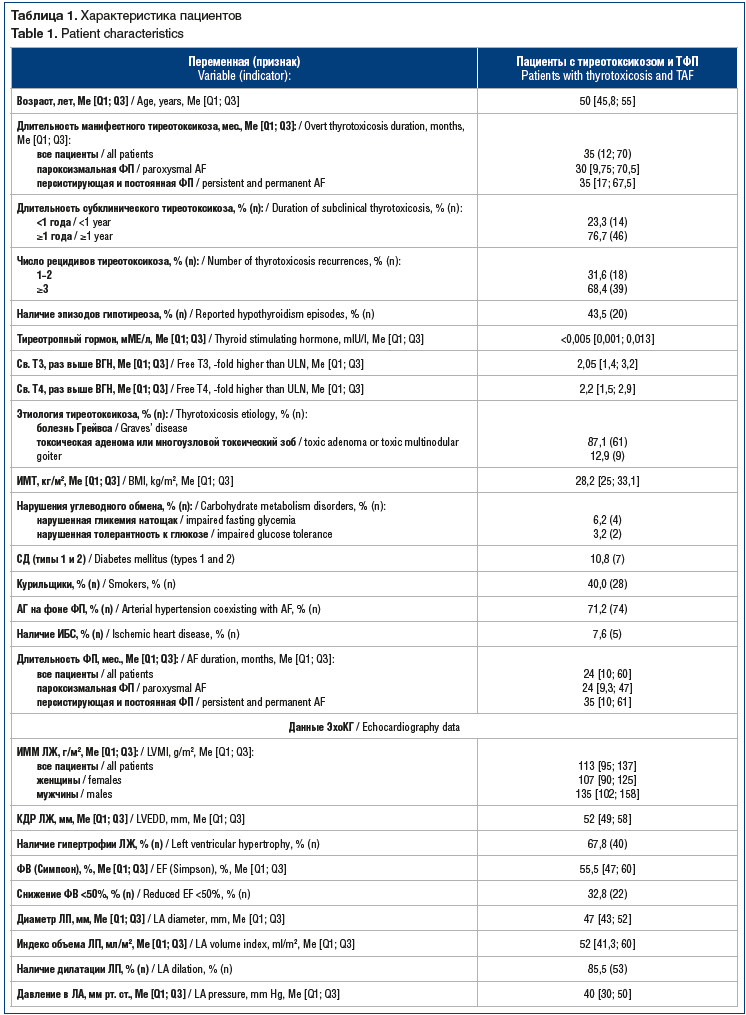
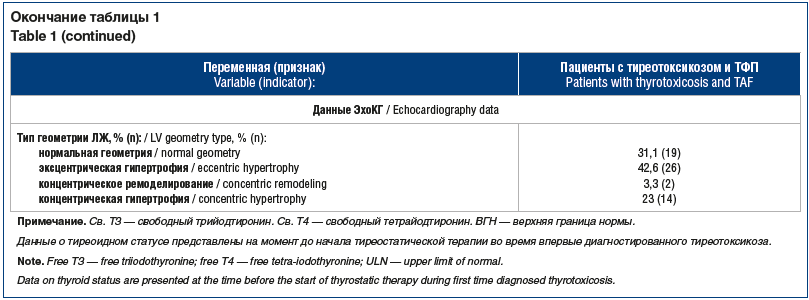
The study included 70 patients (44 women and 26 men) aged 24–70. Patient characteristics are listed in Table 1.
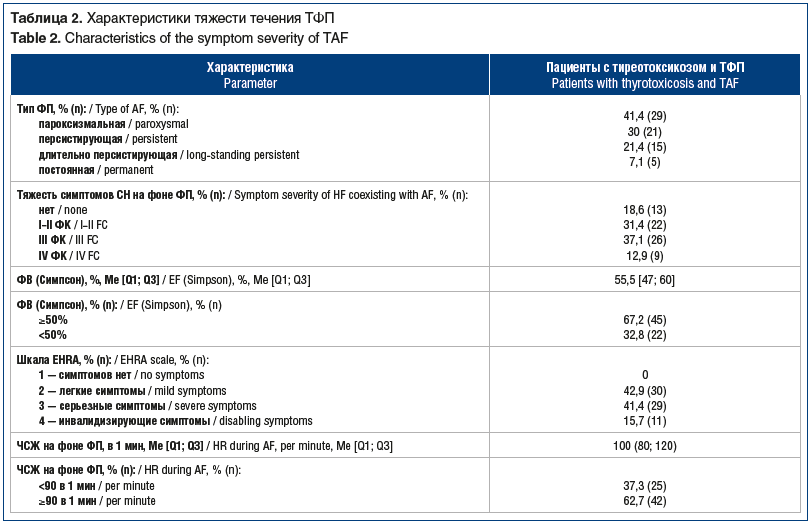
Parameters characterizing TAFib severity are presented in Table 2. Persistent AFib was reported in a half of the patients (less than a year in 30% and more than a year in 21.4%) and paroxysmal AFib in 41.4%. Permanent AFib was diagnosed in 7.1%. Considering the small number of patients with permanent AFib, persistent and permanent AFib were further evaluated together. TAFib symptoms were assessed using the EHRA score. No asymptomatic AFib (EHRA 1) was reported in the study group. 40% had mild symptoms (EHRA 2) and 60% had severe or disabling symptoms (EHRA 3 or 4). HF symptoms in AFib were reported in 80% (FC III-IV in a half of patients, EF <50% in a third of patients). The median VR in AFib was 100 [80; 120] rpm. Meanwhile, ventricular tachysystole was reported not in all patients, i.e., VR was less than 90 rpm in 37.3% (because of HR-lowering therapy).
Factors associated with severe TAFib
Patients with various TAFib severity were compared using parameters listed in Table 1. The following patterns were compared:
1. Paroxysmal AFib or persistent AFib.
2. No FC I–II HF or FC III–IV HF in AFib.
3. Simpson’s EF ≥50% or Simpson’s EF <50%.
4. EHRA 2 or EHRA 3–4.
5. VR in AFib <90 rpm or VR in AFib ≥90 rpm.
Severe TAFib was defined as persistent AFib, FC III–IV HF in AFib, EF <50%, EHRA 3–4, VR ≥90 rpm.
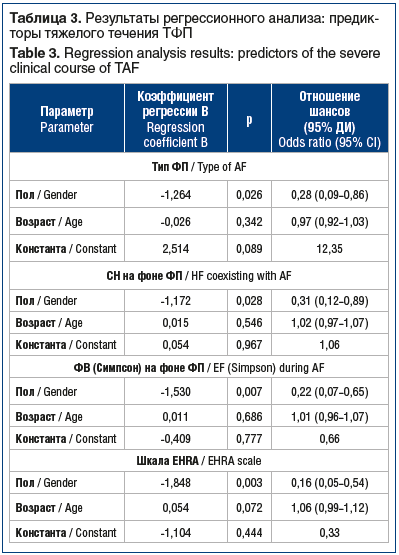
Gender was significantly associated with all parameters of TAFib severity, excepting VR. The percentage of men was significantly higher in persistent AFib than in paroxysmal AFib (48.8% vs. 20.7%, respectively, p=0.017), FC III–IV HF than in FC I–II HF (48.8% vs. 25.7%, respectively, p=0.048), EF <50% than in normal EF (63.3% vs. 26.7%, respectively, p=0.002), and EHRA 3–4 than in EHRA 2 (52.5% vs. 16.7%, respectively, p=0.003).
To establish the effect of gender on TAFib severity, logistic regression including only age and gender as independent variables was performed. Male gender can be regarded as a predictor of persistent AFib, severe HF (FC III–IV and EF <50%), and severe AFib (EHRA 3–4) irrespective of age (see Table 3).
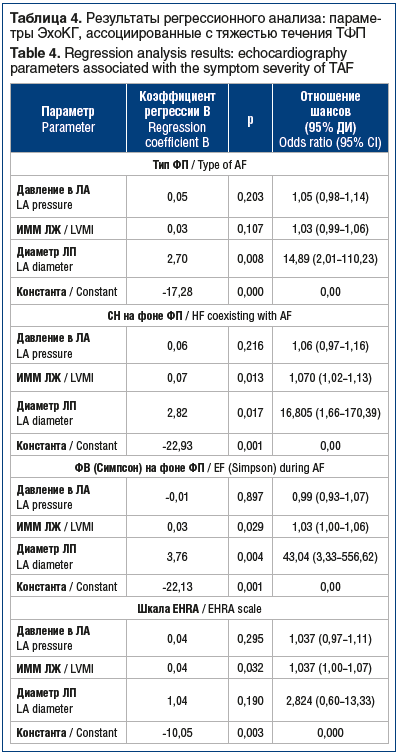
Additionally, some echo findings were associated with parameters describing TAFib severity, i.e., LVMI, LA diameter, and LA pressure. However, logistic regression has demonstrated that only LA diameter is associated with AFib type, LVMI and LA diameter are associated with HF severity and EF, only LVMI is associated with AFib severity, and none of the parameters are associated with VR (see Table 4).
Discussion
The study patients were characterized by a rather severe AFib, since a half of them had FC III-IV HF and symptoms typical of EHRA 3-4. An EF <50% was reported in a third of patients. Persistent AFib was more common (58.6%) than paroxysmal AFib (41.4%), which is in line with earlier studies [2, 3, 7, 8, 13]. We failed to find any published studies on the aforementioned TAFib characteristics describing AFib severity. Meanwhile, our findings on the rate of severe TAFib cannot be translated to all patients with TAFib since most of our patients were the ones who were admitted to the hospital with severe thyrotoxicosis or its complications. This is accounted for by the specificity of medical institutions wh ere patients were enrolled.
The only reliable predictor of severe TAFib was male gender. This factor is associated with persistence AFib, FC III–IV HF, EF <50%, and severe AFib (EHRA 3–4). In contrast to other studies on the effect of clinical parameters, history, and other factors on TAFib type [6], we failed to find any associations between thyrotoxicosis duration, thyroid hormone levels, and TAFib severity. Therefore, special attention should be paid to men with thyrotoxicosis to prevent AFib. Moreover, men with preexisting TAFib require adequate HR-lowering therapy, thyrostatic medications to control the levels of thyroid hormones and TSH, and, optimally, early radical treatment for thyrotoxicosis (thyroidectomy or radioiodine therapy).
Finally, some echo parameters were associated with TAFib severity. LVMI and LA diameter are greater in severe AFib. This is potentially important for prognosis in patients with these echocardiographic abnormalities.
Conclusions
Our findings have demonstrated that male gender is associated with more severe TAFib manifested in persistent AFib, FC III–IV HF, EF <50%, and severe AFib (EHRA 3–4). Therefore, practitioners should be focused on men with other factors increasing TAFib risk. Moreover, our study has found that some echo parameters are associated with TAFib severity, i.e., LA diameter with AFib type, LVMI with AFib severity (by EHRA score), and both parameters with HF functional class and EF in TAFib.
Our study provides important information that help clinically manage patients with TAFib. Given a small sample size, further studies are required to establish and expand the results to develop a tool for risk stratification of severe TAFib and therapeutic and preventive approaches to this disorder.
About the authors:
Daria A. Ponomartseva — endocrinologist of the Endocrinology Department, V.A. Almazov National Medical Research Center; 2, Akkuratov str., St. Petersburg, 197341, Russian Federation; ORCID iD 0000-0002-0434-7808.
Alina Yu. Babenko — Dr. Sc. (Med.), Head of the Research Department of Genetic Risks and Personalized Prevention of the World-Class Scientific Center "Center for Personalized Medicine", Chief Researcher of Laboratory of Diabetology, Professor of the Department of Internal Diseases of the Institute for medical Education, V.A. Almazov National Medical Research Center; 2, Akkuratov str., St. Petersburg, 197341, Russian Federation; ORCID iD 0000-0002-0559-697X.
Contact information: Daria A. Ponomartseva, e-mail: savitskayadaria@gmail.com.
Funding source: the study was performed within State Task No. 26 (Registration No. АААА-А18-118042390142-5).
Financial Disclosure: no authors have a financial or property interest in any material or method mentioned.
There is no conflict of interests.
Received 08.08.2022.
Revised 31.08.2022.
Accepted 23.09.2022.
2. Biondi B., Kahaly G.J. Cardiovascular involvement in patients with different causes of hyperthyroidism. Nat Rev Endocrinol. 2010;6(8):431–443. DOI: 10.1038/nrendo.2010.105.
3. Goldstein S.A., Green J., Huber K. et al. Characteristics and Outcomes of Atrial Fibrillation in Patients With Thyroid Disease (from the ARISTOTLE Trial). Am J Cardiol. 2019;124(9):1406–1412. DOI: 10.1016/j.amjcard.2019.07.046.
4. Komiya N., Isomoto S., Nakao K. et al. Electrophysiological abnormalities of the atrial muscle in patients with paroxysmal atrial fibrillation associated with hyperthyroidism. Clin Endocrinol (Oxf). 2002;56(1):39–44. DOI: 10.1046/j.0300-0664.2001.01459.x.
5. Shimizu T., Koide S., Noh J.Y. et al. Hyperthyroidism and the management of atrial fibrillation. Thyroid. 2002;12(6):489–493. DOI: 10.1089/105072502760143863.
6. Berestennikova L.N., Chumakova G.A. Predictors of paroxysmal thyrotoxic atrial fibrillation. Cardiovascular Therapy and Prevention. 2011;10(5):63–67 (in Russ.). DOI: 10.15829/1728-8800-2011-5-63-67.
7. Kahaly G.J., Dillmann W.H. Thyroid hormone action in the heart. Endocr Rev. 2005;26(5):704–728. DOI: 10.1210/er.2003-0033.
8. Osman F., Franklyn J.A., Holder R.L. et al. Cardiovascular manifestations of hyperthyroidism before and after antithyroid therapy: a matched case-control study. J Am Coll Cardiol. 2007;49(1):71–81. DOI: 10.1016/j.jacc.2006.08.042.
9. Arakelyan M.G., Bockeria L.A., Vasilieva E.Yu. et al. F 2020 Clinical guidelines for Atrial fibrillation and atrial flutter. Russian Journal of Cardiology. 2021;26(7):4594 (in Russ.). DOI: 10.15829/1560-4071-2021-4594.
10. Standards of specialized diabetes care. Dedov I.I., Shestakova M.V., Mayorov A.Yu., eds., 8th ed. M.: UP PRINT; 2017 (in Russ.). 11. Lang R.M., Bierig M., Devereux R.B. et al. Recommendations for chamber quantification: a report from the American Society of Echocardiography’s Guidelines and Standards Committee and the Chamber Quantification Writing Group, developed in conjunction with the European Association of Echocardiography, a branch of the European Society of Cardiology. J Am Soc Echocardiogr. 2005;18(12):1440–1463. DOI: 10.1016/j.echo.2005.10.005.
12. Ganau A., Devereux R.B., Roman M.J. et al. Patterns of left ventricular hypertrophy and geometric remodeling in essential hypertension. J Am Coll Cardiol. 1992;19(7):1550–1558. DOI: 10.1016/0735-1097(92)90617-v.
13. Chan P.H., Hai J., Yeung C.Y. et al. Benefit of Anticoagulation Therapy in Hyperthyroidism-Related Atrial Fibrillation. Clin Cardiol. 2015;38(8):476–482. DOI: 10.1002/clc.22427.

This work is licensed under a Creative Commons «Attribution» 4.0 License.

Распечатать